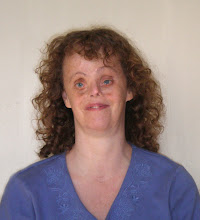
Yeah, yeah, I know the title is pretty much the topic of every entry, but this weekend I had a revelation. The duo Ryanhood mentioned in the previous post performed in San Diego and I was fortunate to catch the second half of their set. Afterward I had nice conversations with both Ryan and Cameron. On my walk home, I tried to understand why their manner toward me is comfortable whilst others make me want to squirm. This is not the first time I have tried to dissect another's demeanor and behavior, but it is the first time I actually found a way to explain it that might make sense to TABs.
I believe people's approaches can be categorized using the following areas:
1. level of pity
2. degree of amazement
3. amount of respect shown
4. how the person seems to think about my difference
5. how the person handles it when my difference becomes relevant
Pity should never be confused with empathy. In the latter, the focus is on how the individual feels about their own situation whereas the former centers around how a person emotionally responds to another's circumstances. Pity is based on perception, thus personal beliefs and assumptions come into play. With me, often a person feels worse about my supposed plight than I do. It is exhibited in phrases like, "Your life must be so hard," "It's such a shame," or simply use of the word suffering.
I think amazement comes from a similar mental process because people think about what they believe they could do if disabled like me and use that yardstick to judge my achievements. Examples include: "I can't believe you baked that," "I couldn't do that if I were," or even a lavish compliment for an every day task.
I do not possess the words to describe respect, but I know it when I see it. Think of the difference between how people treat an adult versus a five year old. There is a tacit belief that an adult can do basic grown up tasks unless evidence emerges that proves otherwise. We do not assume five year olds can cross a street alone, ride the bus without an adult, or order a meal. There are times when I am treated more like that five year old than a mature woman. Of course if I am obviously trying to do something and not managing it, it is not a matter of respect if somebody offers assistance. However, if I decline the help and they question me – "Are you really sure you can do that?" -- it then boils down to respect.
The fourth item on my list can best be illustrated with cats and dogs. Does the person consider one of us a cat and the other a dog or do they consider us different breeds of the same species? In other words, is our difference or our similarity more relevant to them? People who find our difference more salient will often have difficulty finding conversational common ground with an awkward or nervous demeanor. Those who consider our similarities as more germane behave in a natural manner as they would around any other person. Obviously some people are ill-at-ease around anyone which I like to think I can discern reliably.
Finally, if my disability becomes relevant, people handle it in a variety of ways. For example, in illustrating a conversational point, some people will gesture and supply enough words to convey meaning without missing a beat. They do not stop and say, "Oh, Jen, I just did thus and so." My difference never becomes apparent to anyone, but I am also not left feeling different because I cannot follow the conversation. On the other hand, there are people who say the word "see" around me and start apologizing. That makes my difference apparent to me and everyone else in earshot. (Actually, I use the word see along with watch and read telling people it is a matter of using common vernacular, but it is probably more about not highlighting my difference.)
I suspect you can all guess at how I like to be treated– no pity, amazement only at things amazing for any human to achieve, respect due any adult human, similarities more salient than difference, and my disability-related needs being taken into account without disruption. Cameron, Ryan, and people like them allow me to feel comfortable because they obviously do not feel uncomfortable. We are simply equals having a conversation.
I could end here, but one point needs to be made crystal clear. Not every person knows exactly what to do or say. Lack of experience is not a crime for which anyone should be judged. I suppose my list really should have a sixth item – how lack of knowing what to do is handled. Treating it in a matter-of-fact way such as asking a question the way you would ask for the potatoes to be passed is one approach. Another technique might be to give a long preamble about how you don't know how to ask something followed by a question that avoids using the word blind by performing conversational gymnastics. The words used to ask a question are not nearly as important as whether or not my disability is treated like a taboo subject.
I have read through this multiple times and have determined I rather sound like a judgmental jerk. My promise of unflinching honesty prevents me from deleting this. However, I think the criteria are actually a very simple way to summarize a complex set of behaviors that result in me feeling one way or another. For those of you uncertain about what to say or do around a disabled person, maybe they will give you a few useful guidelines.
Showing posts with label Ryanhood. Show all posts
Showing posts with label Ryanhood. Show all posts
Wednesday, October 21, 2009


Wednesday, October 14, 2009
Blindness Can Be Funny
I don't know about you, but I'm in need of some serious levity. And, yes, that is an oxymoron, but you get the idea. This month? The things that happen only because I'm blind.
My grandparent's home is on a lake and as a child, I spent a good portion of my summers there with my sisters and cousins. Except for my grandmother, everyone water-skied. Because of my various reconstructive surgeries, I was forced to wait until the ripe age of eight to learn. To give you perspective, I believe that one cousin was maybe four when she tried it.
For any of you not familiar with the sport, beginners usually learn from the water, squatting in position using the pull of the boat to get up. Only experts stand upright on the dock and jump into the water. Intermediates sit on the edge of the dock and go from there. I will never progress past intermediate.
On my maiden voyage, I went through the routine familiar from enviously watching others do it: I put on my life-vest, wedged my feet into skis, and slid off the dock into the water. I was taught how to crouch so my skis were at an incline with the water's surface, tips pointed upward legs bent so my backside more or less rested on the skis. Then, they gave me a handle attached to the rope and put enough tension on it so I didn't lose my careful positioning. Someone on the boat then yelled, "Hit it!" and we took off.
I let the boat pull me up, just as instructed. Usually, people fall multiple times before reaching this point, so I was very pleased as the boat towed me in a circle. When we neared the dock, the boat honked and I let go sailing over the water toward shore, very proud of myself.
"Jen, didn't you hear us?" everyone on the dock asked.
"No."
"You needed to stand up!"
"What?"
"You don't go around squatting like that. You stand."
"Oh."
I thought being pulled up by the boat meant pulled into a squatting position when the actual objective is standing. Once I tried standing, I fell tons. Actually, I still do, thus the never progressing past intermediate thing.
The above happened simply because I didn't understand a key part of the activity. At other times, my blindness combines with my "I must be right" attitude in amusing ways.
After I developed multiple food intolerances, by necessity I learned how to cook. At the time, the people I knew didn't cook much, so I was impressive in comparison. One friend who stayed with me loved my curried sweet potatoes, so while I was making dinner, I told her the recipe and she wrote it down. One of the ingredients is curry powder, but that can be a widely variable spice from brand to brand and source to source. I reached for the type I was using and suggested she look at the ingredients in order to find an equivalent version.
"Jen, she said, this isn't curry."
"Yes it is," I replied.
"No, it's Cajon seasoning."
"No, the Braille right here says curry."
"And yet the print says Cajon."
Ooops. Now we call them Cajon sweet potatoes. They are still tasty.
When you think about it, it is rather ridiculous that I discount what eyes perceive to the point that I assume the other person is wrong. Here's one final instance.
I was flopped across my couch on my stomach, head pillowed on my arms while my friend occupied the comfy blue chair. At some point in our conversation, she glanced over at the end-table and said, "Ryan's totally hot."
"Huh?"
"This musician on the Ryanhood CD is hot."
"No, you mean Cameron. The group is Ryan Green and Cameron Hood."
"No, I mean Ryan."
"Trust me. Cameron's the hot one."
"He's labeled Ryan on the CD."
"Oh."
From multiple Ryanhood concerts, I had a very vivid impression of both musicians. I took this as a better indication of physical attractiveness than the observations of a sighted person who could actually see the pictures. This is akin to the times when I find out things about my friend's appearance, like their hair color. If it doesn't fit the mental image my mind has constructed of the person, I am totally disconcerted.
I suppose I have just made an excellent argument for me being convinced of my rightness beyond all reason. Somebody will use it against me sooner or later. That really shouldn't be allowed – a violation of the fair fight rules. "Thou shalt not use a blog entry to disprove its author."
My grandparent's home is on a lake and as a child, I spent a good portion of my summers there with my sisters and cousins. Except for my grandmother, everyone water-skied. Because of my various reconstructive surgeries, I was forced to wait until the ripe age of eight to learn. To give you perspective, I believe that one cousin was maybe four when she tried it.
For any of you not familiar with the sport, beginners usually learn from the water, squatting in position using the pull of the boat to get up. Only experts stand upright on the dock and jump into the water. Intermediates sit on the edge of the dock and go from there. I will never progress past intermediate.
On my maiden voyage, I went through the routine familiar from enviously watching others do it: I put on my life-vest, wedged my feet into skis, and slid off the dock into the water. I was taught how to crouch so my skis were at an incline with the water's surface, tips pointed upward legs bent so my backside more or less rested on the skis. Then, they gave me a handle attached to the rope and put enough tension on it so I didn't lose my careful positioning. Someone on the boat then yelled, "Hit it!" and we took off.
I let the boat pull me up, just as instructed. Usually, people fall multiple times before reaching this point, so I was very pleased as the boat towed me in a circle. When we neared the dock, the boat honked and I let go sailing over the water toward shore, very proud of myself.
"Jen, didn't you hear us?" everyone on the dock asked.
"No."
"You needed to stand up!"
"What?"
"You don't go around squatting like that. You stand."
"Oh."
I thought being pulled up by the boat meant pulled into a squatting position when the actual objective is standing. Once I tried standing, I fell tons. Actually, I still do, thus the never progressing past intermediate thing.
The above happened simply because I didn't understand a key part of the activity. At other times, my blindness combines with my "I must be right" attitude in amusing ways.
After I developed multiple food intolerances, by necessity I learned how to cook. At the time, the people I knew didn't cook much, so I was impressive in comparison. One friend who stayed with me loved my curried sweet potatoes, so while I was making dinner, I told her the recipe and she wrote it down. One of the ingredients is curry powder, but that can be a widely variable spice from brand to brand and source to source. I reached for the type I was using and suggested she look at the ingredients in order to find an equivalent version.
"Jen, she said, this isn't curry."
"Yes it is," I replied.
"No, it's Cajon seasoning."
"No, the Braille right here says curry."
"And yet the print says Cajon."
Ooops. Now we call them Cajon sweet potatoes. They are still tasty.
When you think about it, it is rather ridiculous that I discount what eyes perceive to the point that I assume the other person is wrong. Here's one final instance.
I was flopped across my couch on my stomach, head pillowed on my arms while my friend occupied the comfy blue chair. At some point in our conversation, she glanced over at the end-table and said, "Ryan's totally hot."
"Huh?"
"This musician on the Ryanhood CD is hot."
"No, you mean Cameron. The group is Ryan Green and Cameron Hood."
"No, I mean Ryan."
"Trust me. Cameron's the hot one."
"He's labeled Ryan on the CD."
"Oh."
From multiple Ryanhood concerts, I had a very vivid impression of both musicians. I took this as a better indication of physical attractiveness than the observations of a sighted person who could actually see the pictures. This is akin to the times when I find out things about my friend's appearance, like their hair color. If it doesn't fit the mental image my mind has constructed of the person, I am totally disconcerted.
I suppose I have just made an excellent argument for me being convinced of my rightness beyond all reason. Somebody will use it against me sooner or later. That really shouldn't be allowed – a violation of the fair fight rules. "Thou shalt not use a blog entry to disprove its author."
Subscribe to:
Posts (Atom)