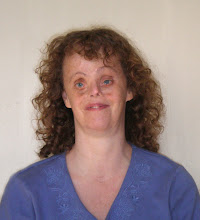
Put two proud, angry and strong disabled people together and interesting ideas will abound. This year I acquired such a person and she keeps saying things that make me think. Fairly fortuitous since I was in need of new blog material.
Here I write constantly about how TABs behave and why for one reason or another it bothers me. It would be easy to have the impression that I want special treatment and more consideration than the average person gives to the average stranger. And, in a way, I do.
When there are 3 kids and 2 chocolate chip cookies, someone must divide them into 3 servings of equal amounts. It is crucial that each child feel the portioning was fair. In life, we often apply this principle to our behavior – treat people the same way and it will be fair. In actuality, that is not remotely the case.
Loading a family's books into a shelving unit, you would naturally put the child's books near the bottom and likely the books interesting the tallest member of the family at the top. Equal would be even distribution of all the books over all the shelves, but would it be fair? Not particularly since shorter individuals would need to climb stepstools. allocation by height and interest is equitable because nobody would need to go to extra effort to achieve the same goal.
When I am isolated in a crowd and feeling invisible, nobody is violating the laws of equalness. They are making eye contact with another person and carrying on a conversation. Equivalent eye contact with me will get them exactly nowhere, so I remain solitary. Having to make additional effort to get my attention creates imbalance, but isn't that equitable?
Sunday, September 5, 2010


Wednesday, September 1, 2010
Becoming Invisible
Sometimes I feel invisible as if I could walk through a room of people naked and nobody would notice. On my part, it's neither intentional nor is its timing under my control. I have also not dawned Harry Potter's cloak of invisibility. Suddenly, without even a puff of smoke, I'm gone.
Because I cannot see people's eyes, I cannot say whether they skim past me, look through me, or simply never turn in my direction. Reading the minds of those around me to truly know what thoughts they entertain is also beyond my abilities. I can say with some authority that people behave as though I am not there. And while I might be small, I'm not microscopic.
The other night I went to a concert with two women I know well. A good friend of one of them met up with us. When we met, he shook my hand and was told my name which my friends used throughout the evening. He giggled with the other total stranger in my female trio. As he had with the other women, he hugged me goodbye. At one point, he made a comment -- "They're talking about people we don't even know." -- that might have been directed at me. I attempted to engage him in small talk twice. While he politely answered my questions, there was absolutely no effort made to further the conversation.
It took me a while to realize it, but for him I didn't really exist except perhaps in relation to the other women. Had he not shaken my hand or hugged me goodbye, he would have been judged rude by my companions. Ditto with my direct remarks to him. His one comment possibly directed at me served the purpose of reinserting himself into the conversation. Otherwise, I was not present.
Here's the thing that seems so contradictory: he is a genuinely nice person. My friend has known him for over ten years and she doesn't spend time and energy on mean people. Even I could tell he was a good person simply by the way he handled himself and the way he spoke. Yet somehow I vanished. Into thin air. For most of the night.
Melissa Etheridge has a line in "Nowhere to Go" that summarizes my theory on all this. "And they don't understand what they don't see/And they look through you and they look past me." In other words, this otherwise nice man couldn't wrap his mind around my existence, so he disappeared me and because I was disappeared, he would never understand me.
Maybe I was showing too many scars. I had on a spaghetti-strap dress, so you could see several, one pretty huge. Maybe I finally met the one person put off by me wearing dark glasses. (A habit I will gladly stop as soon as I know my lack of a right eye won't gross anyone out.) Maybe he didn't think we had anything in common. Maybe he'd never met a blind person. Maybe I had bad breath or smelled.
Honestly, I don't even need to know the why of it. My interest lies in how this particular tendency contributes to those things that make me most frustrated, namely social isolation, trouble making friends, and lack of dates. With my actions, I can force people to notice me. Plaguing this man all night with questions would have done the job, but that is so not my style. I refuse to become obnoxious in order to compensate for another's lacks.
Yet I still involuntarily disappear into thin air. If I could only do it at will, I'd have a far more interesting life with a large bank account.
Thursday, August 19, 2010
Update
Dear Readers,
Anybody notice the last of an entry yesterday? If so, you get a gold star for being observant.
Life has warn me out and I'm taking off some time from blogging. I hope to recharge while visiting my family and floating in a lake. Something resembling regular posting will resume in September.
Thanks for your understanding.
Jen
Wednesday, August 11, 2010
Our Responsibility?
From my last post http://peoplearentbroken.blogspot.com/2010/08/disability-is-responsibility-of.html, you probably figured out I don't think it's fair to make disability the sole responsibility of the disabled. The why of it might elude you. Disabled people are the ones with the "problems," so shouldn't we be the ones to solve them? They are *are* issues and if we want them addressed making it another person's responsibility seems contrary to, well, everything upon which our culture is built.
I do agree the physical difference is contained within me, but it only becomes disability when I try to function within the society humans have constructed. Eyes were chosen as the method for decoding writing instead of something tactile, which makes me disabled. Our language is auditory, making Deaf people disabled when they try to operate in the broader world. Why is our written language visual? Writing developed when light was harder to acquire than flipping a switch would have made a tactile system useful. Why is our language exclusively auditory? A language of gesture was often used in primitive cultures for hunting.
There is no concrete, simple answer as to why society has developed in the manner it has, but it is nonetheless the society we inhabit. Unfortunately, many of its elements turn difference into disability. How does that make disability the responsibility of the disabled? How can society with one hand make me disabled and with the other hold me responsible for fixing it?
I have been pondering whether other marginalized groups are in the same position. Is racial inequity the responsibility of ethnic minorities? Clearly racism is an artifact of our social fabric that has labeled a given physical difference a marker of inferiority. WE do not expect an ethnic minority to educate an employer or check to make sure they are allowed in a public place. We do hold some expectations that they will fight the system, endure greater expense (groceries in the "ghetto"), and answer questions, but as a society we acknowledge the unfairness of such circumstances. Our insistence is that social expectations and societal structures shift to become fair.
Except, of course, when it comes to disability. I hold two elements of our social fabric responsible for this. The pioneer pull yourself up by your bootstraps mentality has so shaped our thinking that we almost automatically look for how an individual is to blame for their plight. Didn't get an A on a math test? It's not because the previous evening your father was beating your mother and you couldn't sleep. No, you didn't study hard enough. Can't walk up that flight of stairs? Well obviously it is your fault because you are the paraplegic so you figure it out. Viewed in this simplistic way, it seems patently absurd to make the person who can't walk up the stairs in charge of the problem. Unable to morph stairs into a ramp, they can only turn away from their goal.
I also believe our social norms about appearance and behavior play a role. WE think people should look a certain way. We think they should act in a particular manner. And when they don't? Wow. Everything about life becomes a little bit harder and that is considered perfectly acceptable. So when a disabled person comes along who may be different in manner or appearance and need unusual things, it falls into a similar category. It's their difference and their problem to solve or not solve.
Legislation attempts to address societal inequities related to disability and has somewhat reallocated responsibility. Unfortunately, although the ADA is twenty years old, it has not changed the minds and hearts of individuals let alone our society's nature. Even the language of the law mandating "reasonable accommodations" unless there is an "undue burden" makes disability equity something to work towards not a concrete benchmark that must be met.
Perhaps the societal shift of responsibility will take more time for the Civil Rights Act of 1965 is twenty-five years older than the ADA. Possibly in 2035 I will not live in a society that finds it acceptable to make me responsible for a physical difference I did not choose. As a sprightly sixty-three-year-old, I am certain it will radically alter my experience.
Wednesday, August 4, 2010
Disability is the responsibility of the Disabled
I have been enraptured by the phrase "disability is the responsibility of the disabled" ever since I discovered it in Unblinkable Difference . In so many ways, it elucidates a nebulous concept I have struggled to articulate. In so many ways, it encapsulates the frustration that fills me routinely.
A Deaf woman goes for a job interview. At some point, she will be asked, "What accommodations will you need to perform this job?" and it will be expected that she provide a detailed list with whatever explanation is necessary to help what is likely an ignorant person understand deafness and all its implications. Should she be hired, she will need to explain repeatedly these exact same things. She will probably have to identify a vendor from whom a TTY can be purchased and then install it herself. Because she is Deaf, she must enlighten the ignorant just to have a job.
A man who uses a wheelchair wants to attend a meetup for people who speak French. An unfamiliar cafe necessitates a phone call to see if there are ramps and a suitable bathroom. He will do a dry run to make sure the person who answered his questions actually knew what "accessible" meant. If there are architectural barriers, he is faced with the choice of asking for the gathering to change venues or not attending. Because he is a paraplegic, this man is responsible for making certain he can attend a public event.
A blind woman wants to get a new cell phone. First she needs to identify a model that is usable tactilely. Next she needs to determine the compatible screenreader and decide if it's functionality suits her needs. Finally, she must not only pay for her phone, which is probably a more expensive model because of her needs, but then pay for the screenreader which is typically an additional $300. Finally, she must seek out an accessible format for the phone's manual and cope with customer service professionals unfamiliar with how a blind person operates a cell phone. Because she is blind, she is responsible to do all necessary research, cope with a phone not designed with her needs in mind, and pay significantly more money than the average person for the privilege. (Apple's I-Phone is the exception to this rule.)
After months of hurting all over and feeling lousy, a man is finally diagnosed with Fibro Myalgia. With no known cure, he and his doctor work to treat the symptoms, but he is still unable to work. Having paid into the Social Security system for fifteen years, he feels no qualms about applying for disability benefits. It takes months for his case to be reviewed and then he is told he does not have a disability and is therefore not eligible for benefits. He must then use his limited energy to find an attorney, get additional medical documentation, write letters, make phone calls, attend hearings, submit to medical exams by government-employed doctors, and juggle surviving with no income. Hopefully he can find the strength and stamina for this test of endurance. At some point, he will maybe receive the benefits he is due, but there will be no compensation for the time and energy he has invested. Because he has Fibro Myalgia, he must fight the system to get what he is entitled.
A Little Person is waiting at a bus stop and is approached by a fellow traveler. Striking up a conversation, the stranger begins to ask questions about being a "midget." Areas of inquiry range from the mundane of driving a car to the intimacies of dating. From experience, the Little Person knows being rude to this stranger will cause the person to hold all Little People responsible. While these questions might be answered in the pages of a book or by surfing the web, the stranger has decided to interrogate this individual. Because she is a Little Person, she must educate the ignorant.
I and the woman who pens Unblinkable Difference contend that our society was constructed around the idea that the person who possesses certain physical conditions is responsible for all things related to it. As a whole, society takes no responsibility for educating oneself, identifying the accessibility of a meeting location, incorporating universal design into products, or providing effective support to battle the system. It is not enough that we must manage our conditions and do whatever is necessary to function with it. Because we are disabled, we are required to educating employers, making phone calls, doing research, paying extra for what we need, fighting the system, and coping with ignorant people.
Is this fair? Is this what other marginalized groups contend with? Is this the way things should be? Next week I'll tackle that part of the issue.
Subscribe to:
Posts (Atom)