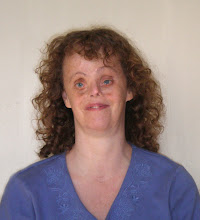
People are nice to me and my reaction isn't pleasure, appreciation, or even embarrassment. Nope, I become utterly baffled. If you think that sounds odd, try living with it.
It all seems to have started with the advent of the prosthetic eyes. Suddenly total strangers were doing weird things like not freaking out, not ignoring me, and even (gasp) being friendly. Coming away from a cafe counter, I might actually be happy instead of cringing. Once I even think I got special treatment not because I'm disabled but because the man was flirting with me. With that one, the earth shifted on its axis and I felt the ground move.
After years of being treated in a certain manner, I honestly have no idea how to assess what is happening. This might seem like a thing to appreciate given that I complain constantly about my frustration with people's less than stellar behavior. Maybe I'm distrustful by nature, but when people behave in inexplicable ways, I start to fret. What am I missing? . Will it last? If I don't understand it, how do I know everything will be alright?
I am expert at dissecting other's odd behavior able to discern nuances and glean motivation from an initial greeting lasting ten seconds. Vast experience has honed my instincts and I am able to know how I should react. When a person holds out their hand and I don't realize it until someone tells me, I know to make a joke to put the other person at ease. If wait staff speaks to my companion about me, I easily insert myself into the conversation in a way that forces the person to interact with me. These are reactions akin to the reflexive jerk of a knee when tapped by a rubber hammer.
In the past, pleasant behavior was easy for me to decipher: the person had prior experience with disabled folks, excellent customer service training, wanted to be friends, and/or rarely wished for something romantic. Everything was simple and clear because it happened less often and the behavior only had a handful of possible motivations.
In contrast, now people are friendly just because. Lacking experience with such behavior, I repeatedly try to fit actions into the categories I know but without success. Instead of letting the puzzle go unsolved, I keep going over it in my mind trying to find some clue I've overlooked.
Do you know how frustrating it can be to not understand why someone is being nice? I guess many of you are used to people behaving in such a manner. Maybe it's how you would feel if people suddenly began gazing over your right shoulder whenever they spoke to you. It feels that arbitrary and inexplicable.
I hope for the sake of my sanity that I learn to read niceness with the skill I can apply to odd behavior. Unfortunately that knowledge took years to acquire and I don't have the patience for that prolonged process again. I also lack the brashness of an early twentysomething that allowed me to directly ask people why they did what they did. I think I need a native guide or something. Volunteers?
Showing posts with label TABs. Show all posts
Showing posts with label TABs. Show all posts
Wednesday, May 4, 2011


Wednesday, October 27, 2010
Under a Microscope
When I am not Becoming Invisible, I exist under a microscope. each motion of my cane, gesture of a hand, or choice in wardrobe is noted by somebody somewhere. While I may be disappeared because people do not understand, I am studied by those trying to understand.
My Disability Partner In Crime directed me to this poem that articulates what it is like to be under constant observation
Following Eyes, even friendly ones, watch what I do and how I do it. It satisfies a curiosity about the way I accomplish daily tasks making me an involuntary educational opportunity. Since I cannot observe people doing it, the act becomes something slightly voyeuristic.
To find out if I need help, Following Eyes monitor me. It's a constant vigilance born of good intent, but still means I am studied. Implicit in that is an inherent doubt about my ability to do something and ask for help when needed. Ironically, I ask for aid less when I'm being scrutinized for "mistakes."
Have you ever noticed that when a disabled person says something makes them uncomfortable, they are often told why someone's intentions should nullify their feelings? I get this from the best of friends who understand disability in all ways possible for a TAB. I hate being continually studied , but because the intent is to learn or help, I am suppose to miraculously be fine with it. Guess what? I'm not fine with it.
I use the phrase "flying under the radar" to describe a state of being where /Following Eyes do not track me everywhere. Unlike becoming invisible, I am simply a person going about her life as much a member of the ubiquitous "public" as the next person. I crave being able to simply be myself perceived on my own terms.
Part of the problem is that I am often the first blind person an individual has ever seen. Curiosity is natural as is a desire to help. Neither gives the Following Eyes any less weight or invalidates the invasion of my personal space. What gives us this sense of privacy is a collective tendency people have of not watching every move another human makes.) With Following Eyes, I achieve personal space only if I ignore what I know is happening.
Can you guess who doesn't have Following Eyes? Close friends who have stopped being constantly conscious of my blindness. Assuming I can do something, knowing I'll ask if I need help, and not being fixated on how I accomplish a task, they look at something more interesting. It becomes a vicious circle where the solution encourages the problem for the familiarity that turns me into something unremarkable is only achieved by exposure to me with observation if not an essential component at least a highly likely side effect.
I cannot impress upon you enough how uncomfortable it is to be watched. Constantly. It's probably akin to someone you don't know undressing you with their eyes ALL THE TIME. Imagine what that's like and get back to me about intent – they're not touching you or even suggesting they do -- nullifying discomfort.
My Disability Partner In Crime directed me to this poem that articulates what it is like to be under constant observation
Following Eyes, even friendly ones, watch what I do and how I do it. It satisfies a curiosity about the way I accomplish daily tasks making me an involuntary educational opportunity. Since I cannot observe people doing it, the act becomes something slightly voyeuristic.
To find out if I need help, Following Eyes monitor me. It's a constant vigilance born of good intent, but still means I am studied. Implicit in that is an inherent doubt about my ability to do something and ask for help when needed. Ironically, I ask for aid less when I'm being scrutinized for "mistakes."
Have you ever noticed that when a disabled person says something makes them uncomfortable, they are often told why someone's intentions should nullify their feelings? I get this from the best of friends who understand disability in all ways possible for a TAB. I hate being continually studied , but because the intent is to learn or help, I am suppose to miraculously be fine with it. Guess what? I'm not fine with it.
I use the phrase "flying under the radar" to describe a state of being where /Following Eyes do not track me everywhere. Unlike becoming invisible, I am simply a person going about her life as much a member of the ubiquitous "public" as the next person. I crave being able to simply be myself perceived on my own terms.
Part of the problem is that I am often the first blind person an individual has ever seen. Curiosity is natural as is a desire to help. Neither gives the Following Eyes any less weight or invalidates the invasion of my personal space. What gives us this sense of privacy is a collective tendency people have of not watching every move another human makes.) With Following Eyes, I achieve personal space only if I ignore what I know is happening.
Can you guess who doesn't have Following Eyes? Close friends who have stopped being constantly conscious of my blindness. Assuming I can do something, knowing I'll ask if I need help, and not being fixated on how I accomplish a task, they look at something more interesting. It becomes a vicious circle where the solution encourages the problem for the familiarity that turns me into something unremarkable is only achieved by exposure to me with observation if not an essential component at least a highly likely side effect.
I cannot impress upon you enough how uncomfortable it is to be watched. Constantly. It's probably akin to someone you don't know undressing you with their eyes ALL THE TIME. Imagine what that's like and get back to me about intent – they're not touching you or even suggesting they do -- nullifying discomfort.
Wednesday, September 22, 2010
An Act of Will
Often when people behave in ways I find objectionable the route explanation is ignorance. They simply lack the knowledge to handle the situation in a "better" way. Expressions of my frustration at the state of affairs elicit the counsel to "have compassion" and sometimes that's even possible. Then there are the times that the ignorance takes on an intentional flavor making me angry.
There's an expression – burying your head in the sand –meaning a person has chosen to not take in knowledge that is offered to them. To me, this constitutes willful ignorance that I find unconscionable because the individual had the option to learn "better" and refused. In fact, I find it worse than someone whose behavior is based on a genuine belief that I am less capable, childlike, pitiable, or whatever. At least in that case the individual has paid attention long enough to listen to another perspective. I may not like their ultimate decision, but respect it as long as it doesn't deny me what I need.
What constitutes willful ignorance? Receiving a request from a dyslexic person for alternative formats with an explanation as to why and two months later acting surprised, baffled, and unprepared when the same inquiry is made. Witnessing how a sighted person assists a blind man and later not knowing what to do. Attending a panel discussion where a wheelchair user explains how insulting the phrase "wheelchair bound" is and continuing to use that phrase over and over. Being given a concrete set of steps for creating alternative formats that is simple and easily done and never doing it. In other words, literally tripping over the facts and pretending the path was clear.
As disabled people become a more visible part of society and their experience better articulated, I see this type of thing with greater frequency and find it utterly incomprehensible. How can a person be told what to do and refuse to do it? Why would they ignore information? What is the mindset that makes this behavior alright? I don't get it. AT all.
Unfortunately, in my own life I am dealing with a case of collective willful ignorance. While I might not understand it or know how to facilitate change, I do know my own limits. I will not lend my talents and energy to benefit a group that buries its collective head in the sand.
I just wish I could wrap my mind around the why of it. While it feels incredibly personal, I suspect it is not. Until I can comprehend the behavior, I know my unanswered questions will rattle around in the back of my mind. Insight welcome.
There's an expression – burying your head in the sand –meaning a person has chosen to not take in knowledge that is offered to them. To me, this constitutes willful ignorance that I find unconscionable because the individual had the option to learn "better" and refused. In fact, I find it worse than someone whose behavior is based on a genuine belief that I am less capable, childlike, pitiable, or whatever. At least in that case the individual has paid attention long enough to listen to another perspective. I may not like their ultimate decision, but respect it as long as it doesn't deny me what I need.
What constitutes willful ignorance? Receiving a request from a dyslexic person for alternative formats with an explanation as to why and two months later acting surprised, baffled, and unprepared when the same inquiry is made. Witnessing how a sighted person assists a blind man and later not knowing what to do. Attending a panel discussion where a wheelchair user explains how insulting the phrase "wheelchair bound" is and continuing to use that phrase over and over. Being given a concrete set of steps for creating alternative formats that is simple and easily done and never doing it. In other words, literally tripping over the facts and pretending the path was clear.
As disabled people become a more visible part of society and their experience better articulated, I see this type of thing with greater frequency and find it utterly incomprehensible. How can a person be told what to do and refuse to do it? Why would they ignore information? What is the mindset that makes this behavior alright? I don't get it. AT all.
Unfortunately, in my own life I am dealing with a case of collective willful ignorance. While I might not understand it or know how to facilitate change, I do know my own limits. I will not lend my talents and energy to benefit a group that buries its collective head in the sand.
I just wish I could wrap my mind around the why of it. While it feels incredibly personal, I suspect it is not. Until I can comprehend the behavior, I know my unanswered questions will rattle around in the back of my mind. Insight welcome.
Wednesday, September 15, 2010
My Brain Hurts
With age is suppose to come wisdom, but as I grow older the human race becomes more baffling. In fact, the deeper my understanding of human motivation the less certainty I possess. And while I suspect this is not unique to the disability experience, I do think my membership in that group adds a layer of complexity to an already jumbled muddle.
Meeting a new person and having a great conversation cannot be taken at face value. We all have to ask ourselves if the friendliness was genuine. Should the answer be yes, most folks move on to determining their next step. I, on the other hand, must then field a second question: Was the friendliness based on a perceived obligation to be nice to a disabled person or on feeling sorry for me? Unfortunately, authentic warmth and that based upon obligation or pity look remarkably similar because the sentiment is genuine and the variation is only that of motive.
I don't think people realize that affability based on duty or sympathy is actually harmful because it sets up an expectation that will not be met. Everyone has mistaken another's actions as an overture of friendship and felt the resulting sting. Now imagine being told that person thought they were doing a "good" thing. It tends to make my brain hurt.
Another case of "The older I get the harder it becomes" revolves around people's "bad" behavior. Take my favorite situation of sitting alone at a party. I find it harder and harder to feel simple anger at such a state of affairs. Instead, my head starts to analyze the situation. What did I do wrong? What dynamics contributed to what occurred? Besides, being angry at behavior based on ignorance or not knowing what to do seems unmerited. More brain pain.
Then you have the truly obnoxious behavior. Perfect real life case in point. Recently, someone I have been acquainted with for years told me how great it was that with both eyes removed I had a chance to look normal. This came on the heels of a prior conversation in which he told me how off-putting my appearance is and how I should hide my eyes behind glasses to make others comfortable. Believe it or not, he's still walking this earth with all his "equipment" in tact.
Did I get angry? Definitely. However, about five seconds later my brain started explaining to me why what he said reflected his generational background, that maybe he mistook my dark glasses as concealing behavior, and I probably misunderstood anyway.
This all happens because I am constantly seeking understanding of why TABs react to disabled people in particular ways. My knowledge base grows almost daily and I can call upon it to interpret actions directed at me. It's like having the traditional angel and devil perched on either shoulder. My angel is a compilation of everyone who tells me to "See it from the other person's perspective" while my devil is the amalgamation of every disabled activist I've ever admired.
Often a blog entry emerges from whatever issue I am currently trying to understand. Prior to sitting down at the computer, I talk – some probably think endlessly – about whatever I am wrestling. This week I have discovered that I feel responsible for how people feel about their less than stellar behavior. Example: I'm with another person and the cashier interacts with my companion while processing what is clearly my stuff. If I were to say, "Umm, that's my stuff so maybe you should talk to me" and the cashier became upset about their own actions, I would feel like I caused their upset.
Fortunately a new perspective has emerged. When a person does something, they are responsible for how they feel about it. My role is to request a change in behavior and be responsible for how I feel about it. In other words, I didn't do anything so how can I be to blame?
Meeting a new person and having a great conversation cannot be taken at face value. We all have to ask ourselves if the friendliness was genuine. Should the answer be yes, most folks move on to determining their next step. I, on the other hand, must then field a second question: Was the friendliness based on a perceived obligation to be nice to a disabled person or on feeling sorry for me? Unfortunately, authentic warmth and that based upon obligation or pity look remarkably similar because the sentiment is genuine and the variation is only that of motive.
I don't think people realize that affability based on duty or sympathy is actually harmful because it sets up an expectation that will not be met. Everyone has mistaken another's actions as an overture of friendship and felt the resulting sting. Now imagine being told that person thought they were doing a "good" thing. It tends to make my brain hurt.
Another case of "The older I get the harder it becomes" revolves around people's "bad" behavior. Take my favorite situation of sitting alone at a party. I find it harder and harder to feel simple anger at such a state of affairs. Instead, my head starts to analyze the situation. What did I do wrong? What dynamics contributed to what occurred? Besides, being angry at behavior based on ignorance or not knowing what to do seems unmerited. More brain pain.
Then you have the truly obnoxious behavior. Perfect real life case in point. Recently, someone I have been acquainted with for years told me how great it was that with both eyes removed I had a chance to look normal. This came on the heels of a prior conversation in which he told me how off-putting my appearance is and how I should hide my eyes behind glasses to make others comfortable. Believe it or not, he's still walking this earth with all his "equipment" in tact.
Did I get angry? Definitely. However, about five seconds later my brain started explaining to me why what he said reflected his generational background, that maybe he mistook my dark glasses as concealing behavior, and I probably misunderstood anyway.
This all happens because I am constantly seeking understanding of why TABs react to disabled people in particular ways. My knowledge base grows almost daily and I can call upon it to interpret actions directed at me. It's like having the traditional angel and devil perched on either shoulder. My angel is a compilation of everyone who tells me to "See it from the other person's perspective" while my devil is the amalgamation of every disabled activist I've ever admired.
Often a blog entry emerges from whatever issue I am currently trying to understand. Prior to sitting down at the computer, I talk – some probably think endlessly – about whatever I am wrestling. This week I have discovered that I feel responsible for how people feel about their less than stellar behavior. Example: I'm with another person and the cashier interacts with my companion while processing what is clearly my stuff. If I were to say, "Umm, that's my stuff so maybe you should talk to me" and the cashier became upset about their own actions, I would feel like I caused their upset.
Fortunately a new perspective has emerged. When a person does something, they are responsible for how they feel about it. My role is to request a change in behavior and be responsible for how I feel about it. In other words, I didn't do anything so how can I be to blame?
Sunday, September 5, 2010
Equal versus Equitable
Put two proud, angry and strong disabled people together and interesting ideas will abound. This year I acquired such a person and she keeps saying things that make me think. Fairly fortuitous since I was in need of new blog material.
Here I write constantly about how TABs behave and why for one reason or another it bothers me. It would be easy to have the impression that I want special treatment and more consideration than the average person gives to the average stranger. And, in a way, I do.
When there are 3 kids and 2 chocolate chip cookies, someone must divide them into 3 servings of equal amounts. It is crucial that each child feel the portioning was fair. In life, we often apply this principle to our behavior – treat people the same way and it will be fair. In actuality, that is not remotely the case.
Loading a family's books into a shelving unit, you would naturally put the child's books near the bottom and likely the books interesting the tallest member of the family at the top. Equal would be even distribution of all the books over all the shelves, but would it be fair? Not particularly since shorter individuals would need to climb stepstools. allocation by height and interest is equitable because nobody would need to go to extra effort to achieve the same goal.
When I am isolated in a crowd and feeling invisible, nobody is violating the laws of equalness. They are making eye contact with another person and carrying on a conversation. Equivalent eye contact with me will get them exactly nowhere, so I remain solitary. Having to make additional effort to get my attention creates imbalance, but isn't that equitable?
Here I write constantly about how TABs behave and why for one reason or another it bothers me. It would be easy to have the impression that I want special treatment and more consideration than the average person gives to the average stranger. And, in a way, I do.
When there are 3 kids and 2 chocolate chip cookies, someone must divide them into 3 servings of equal amounts. It is crucial that each child feel the portioning was fair. In life, we often apply this principle to our behavior – treat people the same way and it will be fair. In actuality, that is not remotely the case.
Loading a family's books into a shelving unit, you would naturally put the child's books near the bottom and likely the books interesting the tallest member of the family at the top. Equal would be even distribution of all the books over all the shelves, but would it be fair? Not particularly since shorter individuals would need to climb stepstools. allocation by height and interest is equitable because nobody would need to go to extra effort to achieve the same goal.
When I am isolated in a crowd and feeling invisible, nobody is violating the laws of equalness. They are making eye contact with another person and carrying on a conversation. Equivalent eye contact with me will get them exactly nowhere, so I remain solitary. Having to make additional effort to get my attention creates imbalance, but isn't that equitable?
Wednesday, September 1, 2010
Becoming Invisible
Sometimes I feel invisible as if I could walk through a room of people naked and nobody would notice. On my part, it's neither intentional nor is its timing under my control. I have also not dawned Harry Potter's cloak of invisibility. Suddenly, without even a puff of smoke, I'm gone.
Because I cannot see people's eyes, I cannot say whether they skim past me, look through me, or simply never turn in my direction. Reading the minds of those around me to truly know what thoughts they entertain is also beyond my abilities. I can say with some authority that people behave as though I am not there. And while I might be small, I'm not microscopic.
The other night I went to a concert with two women I know well. A good friend of one of them met up with us. When we met, he shook my hand and was told my name which my friends used throughout the evening. He giggled with the other total stranger in my female trio. As he had with the other women, he hugged me goodbye. At one point, he made a comment -- "They're talking about people we don't even know." -- that might have been directed at me. I attempted to engage him in small talk twice. While he politely answered my questions, there was absolutely no effort made to further the conversation.
It took me a while to realize it, but for him I didn't really exist except perhaps in relation to the other women. Had he not shaken my hand or hugged me goodbye, he would have been judged rude by my companions. Ditto with my direct remarks to him. His one comment possibly directed at me served the purpose of reinserting himself into the conversation. Otherwise, I was not present.
Here's the thing that seems so contradictory: he is a genuinely nice person. My friend has known him for over ten years and she doesn't spend time and energy on mean people. Even I could tell he was a good person simply by the way he handled himself and the way he spoke. Yet somehow I vanished. Into thin air. For most of the night.
Melissa Etheridge has a line in "Nowhere to Go" that summarizes my theory on all this. "And they don't understand what they don't see/And they look through you and they look past me." In other words, this otherwise nice man couldn't wrap his mind around my existence, so he disappeared me and because I was disappeared, he would never understand me.
Maybe I was showing too many scars. I had on a spaghetti-strap dress, so you could see several, one pretty huge. Maybe I finally met the one person put off by me wearing dark glasses. (A habit I will gladly stop as soon as I know my lack of a right eye won't gross anyone out.) Maybe he didn't think we had anything in common. Maybe he'd never met a blind person. Maybe I had bad breath or smelled.
Honestly, I don't even need to know the why of it. My interest lies in how this particular tendency contributes to those things that make me most frustrated, namely social isolation, trouble making friends, and lack of dates. With my actions, I can force people to notice me. Plaguing this man all night with questions would have done the job, but that is so not my style. I refuse to become obnoxious in order to compensate for another's lacks.
Yet I still involuntarily disappear into thin air. If I could only do it at will, I'd have a far more interesting life with a large bank account.
Because I cannot see people's eyes, I cannot say whether they skim past me, look through me, or simply never turn in my direction. Reading the minds of those around me to truly know what thoughts they entertain is also beyond my abilities. I can say with some authority that people behave as though I am not there. And while I might be small, I'm not microscopic.
The other night I went to a concert with two women I know well. A good friend of one of them met up with us. When we met, he shook my hand and was told my name which my friends used throughout the evening. He giggled with the other total stranger in my female trio. As he had with the other women, he hugged me goodbye. At one point, he made a comment -- "They're talking about people we don't even know." -- that might have been directed at me. I attempted to engage him in small talk twice. While he politely answered my questions, there was absolutely no effort made to further the conversation.
It took me a while to realize it, but for him I didn't really exist except perhaps in relation to the other women. Had he not shaken my hand or hugged me goodbye, he would have been judged rude by my companions. Ditto with my direct remarks to him. His one comment possibly directed at me served the purpose of reinserting himself into the conversation. Otherwise, I was not present.
Here's the thing that seems so contradictory: he is a genuinely nice person. My friend has known him for over ten years and she doesn't spend time and energy on mean people. Even I could tell he was a good person simply by the way he handled himself and the way he spoke. Yet somehow I vanished. Into thin air. For most of the night.
Melissa Etheridge has a line in "Nowhere to Go" that summarizes my theory on all this. "And they don't understand what they don't see/And they look through you and they look past me." In other words, this otherwise nice man couldn't wrap his mind around my existence, so he disappeared me and because I was disappeared, he would never understand me.
Maybe I was showing too many scars. I had on a spaghetti-strap dress, so you could see several, one pretty huge. Maybe I finally met the one person put off by me wearing dark glasses. (A habit I will gladly stop as soon as I know my lack of a right eye won't gross anyone out.) Maybe he didn't think we had anything in common. Maybe he'd never met a blind person. Maybe I had bad breath or smelled.
Honestly, I don't even need to know the why of it. My interest lies in how this particular tendency contributes to those things that make me most frustrated, namely social isolation, trouble making friends, and lack of dates. With my actions, I can force people to notice me. Plaguing this man all night with questions would have done the job, but that is so not my style. I refuse to become obnoxious in order to compensate for another's lacks.
Yet I still involuntarily disappear into thin air. If I could only do it at will, I'd have a far more interesting life with a large bank account.
Wednesday, August 11, 2010
Our Responsibility?
From my last post http://peoplearentbroken.blogspot.com/2010/08/disability-is-responsibility-of.html, you probably figured out I don't think it's fair to make disability the sole responsibility of the disabled. The why of it might elude you. Disabled people are the ones with the "problems," so shouldn't we be the ones to solve them? They are *are* issues and if we want them addressed making it another person's responsibility seems contrary to, well, everything upon which our culture is built.
I do agree the physical difference is contained within me, but it only becomes disability when I try to function within the society humans have constructed. Eyes were chosen as the method for decoding writing instead of something tactile, which makes me disabled. Our language is auditory, making Deaf people disabled when they try to operate in the broader world. Why is our written language visual? Writing developed when light was harder to acquire than flipping a switch would have made a tactile system useful. Why is our language exclusively auditory? A language of gesture was often used in primitive cultures for hunting.
There is no concrete, simple answer as to why society has developed in the manner it has, but it is nonetheless the society we inhabit. Unfortunately, many of its elements turn difference into disability. How does that make disability the responsibility of the disabled? How can society with one hand make me disabled and with the other hold me responsible for fixing it?
I have been pondering whether other marginalized groups are in the same position. Is racial inequity the responsibility of ethnic minorities? Clearly racism is an artifact of our social fabric that has labeled a given physical difference a marker of inferiority. WE do not expect an ethnic minority to educate an employer or check to make sure they are allowed in a public place. We do hold some expectations that they will fight the system, endure greater expense (groceries in the "ghetto"), and answer questions, but as a society we acknowledge the unfairness of such circumstances. Our insistence is that social expectations and societal structures shift to become fair.
Except, of course, when it comes to disability. I hold two elements of our social fabric responsible for this. The pioneer pull yourself up by your bootstraps mentality has so shaped our thinking that we almost automatically look for how an individual is to blame for their plight. Didn't get an A on a math test? It's not because the previous evening your father was beating your mother and you couldn't sleep. No, you didn't study hard enough. Can't walk up that flight of stairs? Well obviously it is your fault because you are the paraplegic so you figure it out. Viewed in this simplistic way, it seems patently absurd to make the person who can't walk up the stairs in charge of the problem. Unable to morph stairs into a ramp, they can only turn away from their goal.
I also believe our social norms about appearance and behavior play a role. WE think people should look a certain way. We think they should act in a particular manner. And when they don't? Wow. Everything about life becomes a little bit harder and that is considered perfectly acceptable. So when a disabled person comes along who may be different in manner or appearance and need unusual things, it falls into a similar category. It's their difference and their problem to solve or not solve.
Legislation attempts to address societal inequities related to disability and has somewhat reallocated responsibility. Unfortunately, although the ADA is twenty years old, it has not changed the minds and hearts of individuals let alone our society's nature. Even the language of the law mandating "reasonable accommodations" unless there is an "undue burden" makes disability equity something to work towards not a concrete benchmark that must be met.
Perhaps the societal shift of responsibility will take more time for the Civil Rights Act of 1965 is twenty-five years older than the ADA. Possibly in 2035 I will not live in a society that finds it acceptable to make me responsible for a physical difference I did not choose. As a sprightly sixty-three-year-old, I am certain it will radically alter my experience.
I do agree the physical difference is contained within me, but it only becomes disability when I try to function within the society humans have constructed. Eyes were chosen as the method for decoding writing instead of something tactile, which makes me disabled. Our language is auditory, making Deaf people disabled when they try to operate in the broader world. Why is our written language visual? Writing developed when light was harder to acquire than flipping a switch would have made a tactile system useful. Why is our language exclusively auditory? A language of gesture was often used in primitive cultures for hunting.
There is no concrete, simple answer as to why society has developed in the manner it has, but it is nonetheless the society we inhabit. Unfortunately, many of its elements turn difference into disability. How does that make disability the responsibility of the disabled? How can society with one hand make me disabled and with the other hold me responsible for fixing it?
I have been pondering whether other marginalized groups are in the same position. Is racial inequity the responsibility of ethnic minorities? Clearly racism is an artifact of our social fabric that has labeled a given physical difference a marker of inferiority. WE do not expect an ethnic minority to educate an employer or check to make sure they are allowed in a public place. We do hold some expectations that they will fight the system, endure greater expense (groceries in the "ghetto"), and answer questions, but as a society we acknowledge the unfairness of such circumstances. Our insistence is that social expectations and societal structures shift to become fair.
Except, of course, when it comes to disability. I hold two elements of our social fabric responsible for this. The pioneer pull yourself up by your bootstraps mentality has so shaped our thinking that we almost automatically look for how an individual is to blame for their plight. Didn't get an A on a math test? It's not because the previous evening your father was beating your mother and you couldn't sleep. No, you didn't study hard enough. Can't walk up that flight of stairs? Well obviously it is your fault because you are the paraplegic so you figure it out. Viewed in this simplistic way, it seems patently absurd to make the person who can't walk up the stairs in charge of the problem. Unable to morph stairs into a ramp, they can only turn away from their goal.
I also believe our social norms about appearance and behavior play a role. WE think people should look a certain way. We think they should act in a particular manner. And when they don't? Wow. Everything about life becomes a little bit harder and that is considered perfectly acceptable. So when a disabled person comes along who may be different in manner or appearance and need unusual things, it falls into a similar category. It's their difference and their problem to solve or not solve.
Legislation attempts to address societal inequities related to disability and has somewhat reallocated responsibility. Unfortunately, although the ADA is twenty years old, it has not changed the minds and hearts of individuals let alone our society's nature. Even the language of the law mandating "reasonable accommodations" unless there is an "undue burden" makes disability equity something to work towards not a concrete benchmark that must be met.
Perhaps the societal shift of responsibility will take more time for the Civil Rights Act of 1965 is twenty-five years older than the ADA. Possibly in 2035 I will not live in a society that finds it acceptable to make me responsible for a physical difference I did not choose. As a sprightly sixty-three-year-old, I am certain it will radically alter my experience.
Wednesday, August 4, 2010
Disability is the responsibility of the Disabled
I have been enraptured by the phrase "disability is the responsibility of the disabled" ever since I discovered it in Unblinkable Difference . In so many ways, it elucidates a nebulous concept I have struggled to articulate. In so many ways, it encapsulates the frustration that fills me routinely.
A Deaf woman goes for a job interview. At some point, she will be asked, "What accommodations will you need to perform this job?" and it will be expected that she provide a detailed list with whatever explanation is necessary to help what is likely an ignorant person understand deafness and all its implications. Should she be hired, she will need to explain repeatedly these exact same things. She will probably have to identify a vendor from whom a TTY can be purchased and then install it herself. Because she is Deaf, she must enlighten the ignorant just to have a job.
A man who uses a wheelchair wants to attend a meetup for people who speak French. An unfamiliar cafe necessitates a phone call to see if there are ramps and a suitable bathroom. He will do a dry run to make sure the person who answered his questions actually knew what "accessible" meant. If there are architectural barriers, he is faced with the choice of asking for the gathering to change venues or not attending. Because he is a paraplegic, this man is responsible for making certain he can attend a public event.
A blind woman wants to get a new cell phone. First she needs to identify a model that is usable tactilely. Next she needs to determine the compatible screenreader and decide if it's functionality suits her needs. Finally, she must not only pay for her phone, which is probably a more expensive model because of her needs, but then pay for the screenreader which is typically an additional $300. Finally, she must seek out an accessible format for the phone's manual and cope with customer service professionals unfamiliar with how a blind person operates a cell phone. Because she is blind, she is responsible to do all necessary research, cope with a phone not designed with her needs in mind, and pay significantly more money than the average person for the privilege. (Apple's I-Phone is the exception to this rule.)
After months of hurting all over and feeling lousy, a man is finally diagnosed with Fibro Myalgia. With no known cure, he and his doctor work to treat the symptoms, but he is still unable to work. Having paid into the Social Security system for fifteen years, he feels no qualms about applying for disability benefits. It takes months for his case to be reviewed and then he is told he does not have a disability and is therefore not eligible for benefits. He must then use his limited energy to find an attorney, get additional medical documentation, write letters, make phone calls, attend hearings, submit to medical exams by government-employed doctors, and juggle surviving with no income. Hopefully he can find the strength and stamina for this test of endurance. At some point, he will maybe receive the benefits he is due, but there will be no compensation for the time and energy he has invested. Because he has Fibro Myalgia, he must fight the system to get what he is entitled.
A Little Person is waiting at a bus stop and is approached by a fellow traveler. Striking up a conversation, the stranger begins to ask questions about being a "midget." Areas of inquiry range from the mundane of driving a car to the intimacies of dating. From experience, the Little Person knows being rude to this stranger will cause the person to hold all Little People responsible. While these questions might be answered in the pages of a book or by surfing the web, the stranger has decided to interrogate this individual. Because she is a Little Person, she must educate the ignorant.
I and the woman who pens Unblinkable Difference contend that our society was constructed around the idea that the person who possesses certain physical conditions is responsible for all things related to it. As a whole, society takes no responsibility for educating oneself, identifying the accessibility of a meeting location, incorporating universal design into products, or providing effective support to battle the system. It is not enough that we must manage our conditions and do whatever is necessary to function with it. Because we are disabled, we are required to educating employers, making phone calls, doing research, paying extra for what we need, fighting the system, and coping with ignorant people.
Is this fair? Is this what other marginalized groups contend with? Is this the way things should be? Next week I'll tackle that part of the issue.
A Deaf woman goes for a job interview. At some point, she will be asked, "What accommodations will you need to perform this job?" and it will be expected that she provide a detailed list with whatever explanation is necessary to help what is likely an ignorant person understand deafness and all its implications. Should she be hired, she will need to explain repeatedly these exact same things. She will probably have to identify a vendor from whom a TTY can be purchased and then install it herself. Because she is Deaf, she must enlighten the ignorant just to have a job.
A man who uses a wheelchair wants to attend a meetup for people who speak French. An unfamiliar cafe necessitates a phone call to see if there are ramps and a suitable bathroom. He will do a dry run to make sure the person who answered his questions actually knew what "accessible" meant. If there are architectural barriers, he is faced with the choice of asking for the gathering to change venues or not attending. Because he is a paraplegic, this man is responsible for making certain he can attend a public event.
A blind woman wants to get a new cell phone. First she needs to identify a model that is usable tactilely. Next she needs to determine the compatible screenreader and decide if it's functionality suits her needs. Finally, she must not only pay for her phone, which is probably a more expensive model because of her needs, but then pay for the screenreader which is typically an additional $300. Finally, she must seek out an accessible format for the phone's manual and cope with customer service professionals unfamiliar with how a blind person operates a cell phone. Because she is blind, she is responsible to do all necessary research, cope with a phone not designed with her needs in mind, and pay significantly more money than the average person for the privilege. (Apple's I-Phone is the exception to this rule.)
After months of hurting all over and feeling lousy, a man is finally diagnosed with Fibro Myalgia. With no known cure, he and his doctor work to treat the symptoms, but he is still unable to work. Having paid into the Social Security system for fifteen years, he feels no qualms about applying for disability benefits. It takes months for his case to be reviewed and then he is told he does not have a disability and is therefore not eligible for benefits. He must then use his limited energy to find an attorney, get additional medical documentation, write letters, make phone calls, attend hearings, submit to medical exams by government-employed doctors, and juggle surviving with no income. Hopefully he can find the strength and stamina for this test of endurance. At some point, he will maybe receive the benefits he is due, but there will be no compensation for the time and energy he has invested. Because he has Fibro Myalgia, he must fight the system to get what he is entitled.
A Little Person is waiting at a bus stop and is approached by a fellow traveler. Striking up a conversation, the stranger begins to ask questions about being a "midget." Areas of inquiry range from the mundane of driving a car to the intimacies of dating. From experience, the Little Person knows being rude to this stranger will cause the person to hold all Little People responsible. While these questions might be answered in the pages of a book or by surfing the web, the stranger has decided to interrogate this individual. Because she is a Little Person, she must educate the ignorant.
I and the woman who pens Unblinkable Difference contend that our society was constructed around the idea that the person who possesses certain physical conditions is responsible for all things related to it. As a whole, society takes no responsibility for educating oneself, identifying the accessibility of a meeting location, incorporating universal design into products, or providing effective support to battle the system. It is not enough that we must manage our conditions and do whatever is necessary to function with it. Because we are disabled, we are required to educating employers, making phone calls, doing research, paying extra for what we need, fighting the system, and coping with ignorant people.
Is this fair? Is this what other marginalized groups contend with? Is this the way things should be? Next week I'll tackle that part of the issue.
Wednesday, June 30, 2010
Happy Blogiversary
As of today, I have been writing this blog for a year, hence the title. At the outset, I was not focused on how the experience might effect me, rather on how it might impact others. Looking back, because even a blind person has 20/20 vision in hindsight, I am mostly aware of lessons learned and changes within myself.
Chronic illness has stripped away awareness of my own abilities and limitations. Can I reliably commit to something that happens every week? Posting entries regularly through the past year of ups and downs has shown me I can stick to a schedule and meet commitments. In the process, I have let go of my tendency to stress excessively and be hyper vigilant. AS the quality has sometimes reflected, I even have (gasp) composed things at the last minute. With such knowledge of my boundaries and abilities, I know I can take on a bigger commitment without falling flat on my face.
I've also discovered I like positive feedback. Whenever one of you posts a comment or I gain another follower, there is some cheering in my house. Praise for something more significant than crossing a street feels great.
Back in 1999, I stopped directly contributing anything to the disabled community. As my energy has increased, I felt guilt for not doing more. I would consider some possible task to undertake only to stop because it felt too huge and I felt ill-equipped. This blog filled a specific drive I possess to change how the world views disability. While it does not reach the masses I would like, it does contributesomething and reaches somebody. To be horribly cliché, I'm following my dream – my heart. Finally.
And then there are the shifts in my perceptions and thinking this experience has evoked. There are a ton of articulate, thoughtful, and spirited disabled people out there saying more or less what I say. At the same time, I have come to know that TABs are not receiving the message. The gulf is somehow wider and deeper than I imagined. More plainly than ever before, I see that only a specific bridge can connect the two sides. Most importantly, I have a clear mental image of how to create that bridge. What I don't know is how to get TABs to pay attention long enough for me to begin. It's like I know steps 3 to 10, but I can't elucidate steps 1 and 2 in my mind.
I think the most surprising result of writing this blog is my take on the word "broken." I just reread my first entry What's Wrong with the Word Broken? and find all it says to still be true. However, I have a more complete understanding. Some people seem to need the concept of broken as applied to themselves so they can conceptualize a kind of rebuilding or rebirth. "I was broken, but now I am whole." It strikes me that integral to this is distinguishing between the present good state and the past "broken" one. It's about acknowledging effort and embracing progress. It's about what it means to say, "I am no longer broken."
I have also discovered something more fundamental than the logic and reason I used to establish my perspective a year ago. Humans are resilient. I would rather focus on how our spirit can weather any storm than how it might shatter upon sharp rocks. Maybe I just like the imagery of something that withstands any force leveled against it. Maybe I am not psychologically capable of even considering humans can break because I fear acknowledging that fact will give my spirit permission to fall into pieces. Especially right now, falling to pieces is not permitted.
I want to leave you with a few questions to ponder on your own. How did you think of disability before beginning to read this blog? Has that changed? Even if you're a friend of mine and have already been educated by me, have there been subtle shifts in understanding? Do you interact with disabled people you encounter differently than before? Do you tend to notice Braille, ramps, and other aspects of accessibility more? Do you discern ways disabled people are excluded more?
Chronic illness has stripped away awareness of my own abilities and limitations. Can I reliably commit to something that happens every week? Posting entries regularly through the past year of ups and downs has shown me I can stick to a schedule and meet commitments. In the process, I have let go of my tendency to stress excessively and be hyper vigilant. AS the quality has sometimes reflected, I even have (gasp) composed things at the last minute. With such knowledge of my boundaries and abilities, I know I can take on a bigger commitment without falling flat on my face.
I've also discovered I like positive feedback. Whenever one of you posts a comment or I gain another follower, there is some cheering in my house. Praise for something more significant than crossing a street feels great.
Back in 1999, I stopped directly contributing anything to the disabled community. As my energy has increased, I felt guilt for not doing more. I would consider some possible task to undertake only to stop because it felt too huge and I felt ill-equipped. This blog filled a specific drive I possess to change how the world views disability. While it does not reach the masses I would like, it does contributesomething and reaches somebody. To be horribly cliché, I'm following my dream – my heart. Finally.
And then there are the shifts in my perceptions and thinking this experience has evoked. There are a ton of articulate, thoughtful, and spirited disabled people out there saying more or less what I say. At the same time, I have come to know that TABs are not receiving the message. The gulf is somehow wider and deeper than I imagined. More plainly than ever before, I see that only a specific bridge can connect the two sides. Most importantly, I have a clear mental image of how to create that bridge. What I don't know is how to get TABs to pay attention long enough for me to begin. It's like I know steps 3 to 10, but I can't elucidate steps 1 and 2 in my mind.
I think the most surprising result of writing this blog is my take on the word "broken." I just reread my first entry What's Wrong with the Word Broken? and find all it says to still be true. However, I have a more complete understanding. Some people seem to need the concept of broken as applied to themselves so they can conceptualize a kind of rebuilding or rebirth. "I was broken, but now I am whole." It strikes me that integral to this is distinguishing between the present good state and the past "broken" one. It's about acknowledging effort and embracing progress. It's about what it means to say, "I am no longer broken."
I have also discovered something more fundamental than the logic and reason I used to establish my perspective a year ago. Humans are resilient. I would rather focus on how our spirit can weather any storm than how it might shatter upon sharp rocks. Maybe I just like the imagery of something that withstands any force leveled against it. Maybe I am not psychologically capable of even considering humans can break because I fear acknowledging that fact will give my spirit permission to fall into pieces. Especially right now, falling to pieces is not permitted.
I want to leave you with a few questions to ponder on your own. How did you think of disability before beginning to read this blog? Has that changed? Even if you're a friend of mine and have already been educated by me, have there been subtle shifts in understanding? Do you interact with disabled people you encounter differently than before? Do you tend to notice Braille, ramps, and other aspects of accessibility more? Do you discern ways disabled people are excluded more?
Wednesday, April 21, 2010
The Stories WE Tell
Because they are primarily associated with creations of fiction, Stories have acquired a bad reputation. When the word refers to events in our lives, it calls their validity into question. In this blog, I tell stories frequently in the hopes that they will convey a truth better than an explicit statement for "Truth dressed as story can be easier to embrace." The color of context, character and surroundings does not dilute or nullify the genuineness of my experiences, but it does transform it into something softer. Same end message with a more pleasant mode of receiving it.
Our lives can be framed as a series of stories we tell ourselves and others. It goes beyond anecdotes to encompass an overall message. My story, for example, is about how disability has shaped me giving it the power of a character that can impact plot. My life contains a story about how circumstances impact two people in very distinct ways. My presence out in the world tells anyone listening how what is thought to be life-ending can be the opposite.
Unspoken stories – those conveyed without me saying a word – have one kind of power. My spoken narrative, I have found, has a transformational strength uniquely its own. I can give a lecture with facts and theory that articulates why plastic surgery is a solution to body image issues that appeals because it takes less effort but also has a shelf-life because we all age. I can also stand before a room telling a string of stories about my experiences with reconstructive surgery and how I felt by it's end. Then, I can describe the various events and phases that morphed my body image into something healthier. While the same truth is conveyed, the one with greater transmutative power contains my life stories.
And then there are the stories about me that other's create. They are woven around the 'truths' of my life others believe they know, such as my life is full of hardships, I must possess special abilities as compensation, or even simply I cannot do x activity. From I cannot drive," they imagine a tragedy of isolation and loneliness with me as the unfortunate protagonist. As is the case with that example, there can be a kernel of truth in the reality they have fashioned. Just enough truth so that a vague vision gains the substance of fact in the inventor's mind.
When I run up against people who are operating based on these supposed facts, I tend to feel like I've hit an unmovable wall. There I stand, a living, breathing contradiction of their story, and yet it has no power to change the plot or elements of their tale. I often must engage in gorilla tactics to cause alteration. One always successful ploy is to say something that involves the phrase "I am the co-coordinator of the San Diego Bisexual Forum."
I would have less objection to these narratives if they did not inform action. People creating stories about my helplessness is one thing. People treating me like I'm helpless is quite another. Behavior of others evokes tears and yells, frustration and pain. Ultimately, I tend to take such events, treat them with sarcastic humor, and create my own stories to lessen their sting.
Unfortunately, sometimes the stories spun by others have sway over even me, especially when it comes to narratives about my value as a person. Often such tales begin with incontrovertible truths such as I don't work or pay taxes, I receive social welfare aid, and I need help to accomplish daily tasks. Intertwined with these truths are societal beliefs about independence, what is considered a worthy contribution to the world, and what is assumed about my ability to achieve. Suddenly, a story springs forth that has enough truth to make it as insidious as sand on a beach. One minute it's on the ground under your shoes and the next it's in your socks, stuck to your leg, and in your clothes. While you might clean it off with great dedication, it's somehow present that night when you undress.
It bothers me that other's stories profoundly effect me, engendering self-doubt and feelings of unworthiness. I wish I had a way to wall myself off from all of it. But, if I am going to believe in the transformative power of my own story, then I must acknowledge and accept that the stories others imagine for me have their own influence. This is why no matter how long I live or how hard I try, I will forever be effected by what others think.
Our lives can be framed as a series of stories we tell ourselves and others. It goes beyond anecdotes to encompass an overall message. My story, for example, is about how disability has shaped me giving it the power of a character that can impact plot. My life contains a story about how circumstances impact two people in very distinct ways. My presence out in the world tells anyone listening how what is thought to be life-ending can be the opposite.
Unspoken stories – those conveyed without me saying a word – have one kind of power. My spoken narrative, I have found, has a transformational strength uniquely its own. I can give a lecture with facts and theory that articulates why plastic surgery is a solution to body image issues that appeals because it takes less effort but also has a shelf-life because we all age. I can also stand before a room telling a string of stories about my experiences with reconstructive surgery and how I felt by it's end. Then, I can describe the various events and phases that morphed my body image into something healthier. While the same truth is conveyed, the one with greater transmutative power contains my life stories.
And then there are the stories about me that other's create. They are woven around the 'truths' of my life others believe they know, such as my life is full of hardships, I must possess special abilities as compensation, or even simply I cannot do x activity. From I cannot drive," they imagine a tragedy of isolation and loneliness with me as the unfortunate protagonist. As is the case with that example, there can be a kernel of truth in the reality they have fashioned. Just enough truth so that a vague vision gains the substance of fact in the inventor's mind.
When I run up against people who are operating based on these supposed facts, I tend to feel like I've hit an unmovable wall. There I stand, a living, breathing contradiction of their story, and yet it has no power to change the plot or elements of their tale. I often must engage in gorilla tactics to cause alteration. One always successful ploy is to say something that involves the phrase "I am the co-coordinator of the San Diego Bisexual Forum."
I would have less objection to these narratives if they did not inform action. People creating stories about my helplessness is one thing. People treating me like I'm helpless is quite another. Behavior of others evokes tears and yells, frustration and pain. Ultimately, I tend to take such events, treat them with sarcastic humor, and create my own stories to lessen their sting.
Unfortunately, sometimes the stories spun by others have sway over even me, especially when it comes to narratives about my value as a person. Often such tales begin with incontrovertible truths such as I don't work or pay taxes, I receive social welfare aid, and I need help to accomplish daily tasks. Intertwined with these truths are societal beliefs about independence, what is considered a worthy contribution to the world, and what is assumed about my ability to achieve. Suddenly, a story springs forth that has enough truth to make it as insidious as sand on a beach. One minute it's on the ground under your shoes and the next it's in your socks, stuck to your leg, and in your clothes. While you might clean it off with great dedication, it's somehow present that night when you undress.
It bothers me that other's stories profoundly effect me, engendering self-doubt and feelings of unworthiness. I wish I had a way to wall myself off from all of it. But, if I am going to believe in the transformative power of my own story, then I must acknowledge and accept that the stories others imagine for me have their own influence. This is why no matter how long I live or how hard I try, I will forever be effected by what others think.
Wednesday, November 18, 2009
Chip on my shoulder
I have a friend who instinctively understands the way I experience the world as a disabled woman with one notable exception: we often argue about the psychology behind others' behavior. Usually it comes up when I'm griping about being ignored in some social situation. While some people try to convince me everyone is isolated in group settings making my experience commonplace, this particular friend acknowledges the behavior and its uniqueness, but contends my understanding of motivation is totally off base. Her position has changed instantaneously, utterly, and unequivocally.
The transformation was accomplished by the experiences of David Mixner, a writer and long-time activist on issues of civil rights, HIV/AIDS, sexual orientation, and war. Recovering from illness, Mixner needed to use a wheelchair and was blown away by what he discovered which he chronicled at http://www.davidmixner.com/2009/11/hells-kitchen-journal-my-view-from-a-wheelchair.html. I told my friend a brief version of what happened to Mixner when he sat in his chair at a Whitehouse event attended by many of his friends and acquaintances. Previously these individuals would have approached to converse, but while Mixner occupied that chair, he received a few nods and smiles with little actual contact. Essentially, he was ignored.
After I conveyed the incident, my friend said, "Wow, that makes no sense. You must be right about people thinking you're contagious or something." Like most, I enjoy being told I'm right, but the conversation did not leave me with the glow of long overdue validation, instead a vague disquiet. It took the words of a TAB stranger to accomplish what years of conversation could not despite my academic background in Disability Studies and lifetime of experience. I felt irrelevant.
Loathing that feeling, I tried to wrap my mind around why people dismiss my observations and hypothesized reasons for behavior. One possibility is simple – if I cannot see what people are doing, how can I observe with accuracy? Ears. I have ears. I realize that reliance upon sight causes most to not comprehend what can be determined by sound, but I am an expert at the auditory. Sighted people read body language and I read the language of tone, act, and reaction. Unfortunately, ears are not granted the reliability of eyes, but if a tree falls in the forest and you only hear it does that mean it didn't happen?
My perceptions and theorizing are dismissed for other reasons as well. If my observations were granted validity, then people would have to also recognize humans are often idiots. It is far easier to decide one person is wrong than to acknowledge we live in the kind of world where individuals are ignored because they are sitting down instead of standing. Refusal to concede this truth does not prove its falseness, rather it hinders social progress for admission of the problem must occur before it can be addressed.
The most frequently mentioned reason that my observations and hypotheses are wrong is the chip I carry on my shoulder. Apparently I mostly have a bad attitude when it comes to TABs. I jump to the wrong conclusions, create motivations out of nothing, and generally take everything personally. Guess what? That's all entirely true.
My chip has been formed over time shaped by accumulated experience filtered through my personality. The balance of formative data tends to be negative creating chips, but there are also people who have been fashioned by positive events. No maladaptive stigma is associated with their perceptual tendencies. Whether burdened by a chip or not, probabilities, predictions, and assumptions are the tools we all use to navigate life from relying upon our alarm clock to wake us to knowing the waiter will bring you food after you have ordered. Because my assumptions are about negative things they are transformed from advantageous life strategies to bitter conjecture.
I confess here and now that I misinterpret behavior and motivations with some frequency, but I am right more than I'm wrong. When possible, I'll check my assumptions with the person, often interrogating a friend about their initial reaction to me. I compare notes with other disabled people, read memoirs of disabled folks, and study how other disabled people are treated in my presence. Speculative though my conclusions may be, they are not made in a vacuum nor are they rigidly carved in stone. New data changes old impressions and I try to maintain flexible thinking. I am completely certain I make mistakes, form inaccurate conclusions, and think not nice things about good people. I admit to being human.
Negative though my interpretations might be, they are not necessarily false. While I wish we lived in a world where my physical difference did not impact the actions of others, I have witnessed a different reality that refuses to submit to my will. I am going to leave you with an often repeated sequence of events. Perhaps you will find an explanation that I have yet to consider.
I walk up to a bathroom and there is a line. Somebody either at the front or in the middle of the line says that I should go before them. This offer has not been made to anyone else. Polite refusal tends to meet with insistence on the part of the offeror. How is this neither ignorant nor condescending?
The transformation was accomplished by the experiences of David Mixner, a writer and long-time activist on issues of civil rights, HIV/AIDS, sexual orientation, and war. Recovering from illness, Mixner needed to use a wheelchair and was blown away by what he discovered which he chronicled at http://www.davidmixner.com/2009/11/hells-kitchen-journal-my-view-from-a-wheelchair.html. I told my friend a brief version of what happened to Mixner when he sat in his chair at a Whitehouse event attended by many of his friends and acquaintances. Previously these individuals would have approached to converse, but while Mixner occupied that chair, he received a few nods and smiles with little actual contact. Essentially, he was ignored.
After I conveyed the incident, my friend said, "Wow, that makes no sense. You must be right about people thinking you're contagious or something." Like most, I enjoy being told I'm right, but the conversation did not leave me with the glow of long overdue validation, instead a vague disquiet. It took the words of a TAB stranger to accomplish what years of conversation could not despite my academic background in Disability Studies and lifetime of experience. I felt irrelevant.
Loathing that feeling, I tried to wrap my mind around why people dismiss my observations and hypothesized reasons for behavior. One possibility is simple – if I cannot see what people are doing, how can I observe with accuracy? Ears. I have ears. I realize that reliance upon sight causes most to not comprehend what can be determined by sound, but I am an expert at the auditory. Sighted people read body language and I read the language of tone, act, and reaction. Unfortunately, ears are not granted the reliability of eyes, but if a tree falls in the forest and you only hear it does that mean it didn't happen?
My perceptions and theorizing are dismissed for other reasons as well. If my observations were granted validity, then people would have to also recognize humans are often idiots. It is far easier to decide one person is wrong than to acknowledge we live in the kind of world where individuals are ignored because they are sitting down instead of standing. Refusal to concede this truth does not prove its falseness, rather it hinders social progress for admission of the problem must occur before it can be addressed.
The most frequently mentioned reason that my observations and hypotheses are wrong is the chip I carry on my shoulder. Apparently I mostly have a bad attitude when it comes to TABs. I jump to the wrong conclusions, create motivations out of nothing, and generally take everything personally. Guess what? That's all entirely true.
My chip has been formed over time shaped by accumulated experience filtered through my personality. The balance of formative data tends to be negative creating chips, but there are also people who have been fashioned by positive events. No maladaptive stigma is associated with their perceptual tendencies. Whether burdened by a chip or not, probabilities, predictions, and assumptions are the tools we all use to navigate life from relying upon our alarm clock to wake us to knowing the waiter will bring you food after you have ordered. Because my assumptions are about negative things they are transformed from advantageous life strategies to bitter conjecture.
I confess here and now that I misinterpret behavior and motivations with some frequency, but I am right more than I'm wrong. When possible, I'll check my assumptions with the person, often interrogating a friend about their initial reaction to me. I compare notes with other disabled people, read memoirs of disabled folks, and study how other disabled people are treated in my presence. Speculative though my conclusions may be, they are not made in a vacuum nor are they rigidly carved in stone. New data changes old impressions and I try to maintain flexible thinking. I am completely certain I make mistakes, form inaccurate conclusions, and think not nice things about good people. I admit to being human.
Negative though my interpretations might be, they are not necessarily false. While I wish we lived in a world where my physical difference did not impact the actions of others, I have witnessed a different reality that refuses to submit to my will. I am going to leave you with an often repeated sequence of events. Perhaps you will find an explanation that I have yet to consider.
I walk up to a bathroom and there is a line. Somebody either at the front or in the middle of the line says that I should go before them. This offer has not been made to anyone else. Polite refusal tends to meet with insistence on the part of the offeror. How is this neither ignorant nor condescending?
Wednesday, November 4, 2009
Desperately Seeking Angry Jen
Lately I have been unable to avoid the fact that I have changed and not for the better. Instead of being filled with indignant rage at acts of disablism, I start thinking about how the other person must feel, make excuses for bad behavior, or let obnoxious attitudes continue unchallenged. Even in this blog, where I try to be so honest, I avoid certain topics, including examples that involve people currently in my life because I do not wish to upset friends or family with my words.
Vague feelings of missing my former self have been around for a while, only coming to a head as a result of a recent event. Apologies to the person involved. Or maybe that should be gratitude since I finally confronted something important. I was at a bonfire roasting my hot dog over the flames. Across the blaze, A friend looked over and told me my face was extremely red. To me, this was not a big deal, but my friend persisted. Blaming the redness on a failure of sunscreen changed nothing. He wouldn't drop it until I moved back. A lot.
Did this annoy me? Definitely, but I made light of it because I recognized he had just hit the "overly concerned" phase most go through when getting to know me. What would be cause for worry for most people is not even a blip on my personal radar since my body does odd things all the time. Fretting is reserved for big events, like my face swelling and hurting so much that it interferes with eating. Though I appreciated being told, I didn't appreciate the degree of concern persisting past me saying everything was fine.
Why didn't I say something? I recognized what was happening and knew the phase would pass. Rather than force the issue, I let go. Formerly, I would have spoken up asking him to back off and show some respect for me by accepting it when I said things were fine. I want to know where that Jen is now.
As one of my earlier entries indicated, 2009 has brought up tons of romantic relationship issues for me. One unfortunate part of dating is how friends and family of the other person react to me. Often, badly. Grandfathers try to talk their grandsons out of seeing me expressing concerns about how much care and attention I will require. Mothers have tried to talk their sons out of dating me. Friends have expressed concerns. It is ridiculous, disablist, and based on misconceptions about me along with a complete disregard for my positive qualities.
I was pondering this happening again a few days after the bonfire situation. Guess what I realized? These concerned friends and relatives are just going through a phase and once they know me they will get over it. Hello? Where's my indignation? Do I really think I should stand by and let this happen? I thought passive tolerance of outright stupidity was not my thing, but apparently I've changed --I am fine with being valued less than a cat.
One more example that has informed my opinion that I've lost my edge. A friend has a couple of kids who I have been around frequently. Earlier this year, when one of these kids was asked about me, she said something like, "Oh, so and so helps her." There was not a thought given to all the things I do for myself let alone any of my talents and abilities. I was reduced to somebody in need of help. Made me so mad I almost screamed.
Instead, I brought my concerns to a friend of the family, who said it was no big deal. I let that convince me to leave it alone. In the past, I would have sat the child down and explained to her that while I did need help occasionally, I also did many things for myself sometimes even helping others. In asking her specific questions, I could have reminded her of all she has seen me do independently. Even teaching her something I could do that she could not would have fostered positive change.
From the above incidents, I have been left with a muddy tangle of feelings magnified by my own frustration with my passivity. I have become so keenly aware of how others feel that I have made myself tolerate what I know is wrong. The "mustn't offend" has overpowered the "I'm offended."
I dearly miss the cleansing fire of pure anger -- the certainty of knowing people should not say/act /perpetuate the things they do. There is a sense of self-worth inherent in the knowledge that another person is wrong, not based on superiority but on knowing humanity and individuals can and should do better. While I like myself more now than at any other time in my life, I am aware the clear flame of anger would add something I currently lack. Becoming a person filled with anger who lacks human compassion is not for me, but neither is this passive person I have become. Somehow I want to reclaim the good parts of that kick ass, take names woman of years ago while leaving the bitterness and self-hatred behind. I must temper indignation with compassion exercising grace and tact. As we all know, I have those two things in abundance. (Yes, that was sarcasm.)
Vague feelings of missing my former self have been around for a while, only coming to a head as a result of a recent event. Apologies to the person involved. Or maybe that should be gratitude since I finally confronted something important. I was at a bonfire roasting my hot dog over the flames. Across the blaze, A friend looked over and told me my face was extremely red. To me, this was not a big deal, but my friend persisted. Blaming the redness on a failure of sunscreen changed nothing. He wouldn't drop it until I moved back. A lot.
Did this annoy me? Definitely, but I made light of it because I recognized he had just hit the "overly concerned" phase most go through when getting to know me. What would be cause for worry for most people is not even a blip on my personal radar since my body does odd things all the time. Fretting is reserved for big events, like my face swelling and hurting so much that it interferes with eating. Though I appreciated being told, I didn't appreciate the degree of concern persisting past me saying everything was fine.
Why didn't I say something? I recognized what was happening and knew the phase would pass. Rather than force the issue, I let go. Formerly, I would have spoken up asking him to back off and show some respect for me by accepting it when I said things were fine. I want to know where that Jen is now.
As one of my earlier entries indicated, 2009 has brought up tons of romantic relationship issues for me. One unfortunate part of dating is how friends and family of the other person react to me. Often, badly. Grandfathers try to talk their grandsons out of seeing me expressing concerns about how much care and attention I will require. Mothers have tried to talk their sons out of dating me. Friends have expressed concerns. It is ridiculous, disablist, and based on misconceptions about me along with a complete disregard for my positive qualities.
I was pondering this happening again a few days after the bonfire situation. Guess what I realized? These concerned friends and relatives are just going through a phase and once they know me they will get over it. Hello? Where's my indignation? Do I really think I should stand by and let this happen? I thought passive tolerance of outright stupidity was not my thing, but apparently I've changed --I am fine with being valued less than a cat.
One more example that has informed my opinion that I've lost my edge. A friend has a couple of kids who I have been around frequently. Earlier this year, when one of these kids was asked about me, she said something like, "Oh, so and so helps her." There was not a thought given to all the things I do for myself let alone any of my talents and abilities. I was reduced to somebody in need of help. Made me so mad I almost screamed.
Instead, I brought my concerns to a friend of the family, who said it was no big deal. I let that convince me to leave it alone. In the past, I would have sat the child down and explained to her that while I did need help occasionally, I also did many things for myself sometimes even helping others. In asking her specific questions, I could have reminded her of all she has seen me do independently. Even teaching her something I could do that she could not would have fostered positive change.
From the above incidents, I have been left with a muddy tangle of feelings magnified by my own frustration with my passivity. I have become so keenly aware of how others feel that I have made myself tolerate what I know is wrong. The "mustn't offend" has overpowered the "I'm offended."
I dearly miss the cleansing fire of pure anger -- the certainty of knowing people should not say/act /perpetuate the things they do. There is a sense of self-worth inherent in the knowledge that another person is wrong, not based on superiority but on knowing humanity and individuals can and should do better. While I like myself more now than at any other time in my life, I am aware the clear flame of anger would add something I currently lack. Becoming a person filled with anger who lacks human compassion is not for me, but neither is this passive person I have become. Somehow I want to reclaim the good parts of that kick ass, take names woman of years ago while leaving the bitterness and self-hatred behind. I must temper indignation with compassion exercising grace and tact. As we all know, I have those two things in abundance. (Yes, that was sarcasm.)
Wednesday, September 16, 2009
Playing the Blind Card
Thanks to SW for asking the question leading to this topic.
Aside from the TAB behaviors I've previously mentioned, people have a tendency to go to extremes around me with their nice, helpful attitude that manifest in many ways from people running to open a door to drivers who, despite a green light, stop at an intersection so I can cross. (By the way, don't do that because it's not helpful. How do I know why you've stopped? Will other drivers do the same?)
If my arms were full of stuff, the dash to open a door for me would make sense, but it rarely happens under those circumstances. Similarly, stopping the car is a polite gesture when a sighted person is with me, but otherwise makes the situation harder. I far prefer the reasonable action people in my neighborhood have adopted of calling out that the light just turned green. In other words, balanced behavior that helps is terrific, but when people go to extremes it's unnecessary and often problematic
I have to be very careful about this tendency of individuals to go above and beyond when it comes to me. I complain about the negative ways people behave because I'm disabled and the positives should be equally abhorrent. Sometimes the perks distract me with the pleasurable possibility and I become a hypocrite – something I loathe. For example, strangers occasionally insist I get in front of them in a line. While that might make sense if my fatigue level is high, it really has no advantage to me as a blind person, which is why it's done since my chronic illness is hidden. Now, with a long line, who wouldn't want to cut in front of somebody? I usually try to say no, but people can get weirdly determined I accept. Really determined. Sometimes I don't refuse simply because I do not wish to battle over it – squanders my time and energy. In fact, I have been known to acquiesce even if the "help" will in actuality be harmful.
There are times and situations where I do need something because I am blind and implying that results in people stumbling over themselves to meet my need. Every so often, I have been known to use this to my advantage when it is not strictly necessary or when my need has nothing to do with me being blind. I refer to this as "playing the blind card." For example, if I have an item I genuinely need to return and it's past the specified date, I take the item in myself and see if I'll get some flexibility. Generally, it works. However, as I said before, I am careful about not exercising the power of my blindness unless absolutely necessary. Doing it for selfish reasons requires complete self-honesty.
Last week I had occasion to play the blind card while planning a bike outing for a group of friends. Since I needed a tandem, I picked an area with a rental place that stocked them. Unfortunately, when I called, I discovered a malevolent spirit rendered every single bicycle inoperative. Suggested places in the area had been similarly plagued. I switched our departure point to a shop that had functional equipment, but when I called to reserve my bike, I was told they didn't take reservations – definitely suboptimal. After consideration, I called back and begged the bored, dismissive clerk to make an exception. No luck, so I slapped down the blind card. "Look, I'm blind and if I show up and you don't have a tandem I cannot take part in a group activity." The very tone of his voice changed and he literally stumbled over his words to accommodate me. I hung up the phone feeling very slimy. Yes, my blindness actually made an exception to the policy reasonable and if he had acknowledge that in the same tone of voice and matter a factly gave me what I needed, it would have been fine. His overly helpful attitude made me feel dirty.
The day of the outing came and the complications that had been plaguing the event continued. I reached my personal limit and cancelled the excursion. I knew I needed to call the bike shop and tell them, but the thought made me sick to my stomach. Channeling a four year old, I let my friend do it and when she called, they said bikes were never reserved and they didn't know anything about an exception. Perfect. Mr. Helpful apparently slimed all over me and didn't do what he said.
That is only one example of how playing the blind card can blow up in your face. A more subtle and insidious consequence is that it can perpetuate the idea that a blind individual is not a competent person for if I beg help based on my visual limitations it confirms that I cannot do something. Often that confirmation spills over into other areas causing a person to conclude that, if I can't do one thing then I cannot do any of the others that their mind imagines. Hence, asking for something with blindness as the reason might mean a less pleasant future encounter. Therefore, occasionally when I need something because I am blind I go without it to avoid reinforcing a TAB's assumptions. Life can become a very complicated balancing act where what I need must be weighed against the long term consequences of receiving it.
For this very reason, I frequently hesitate to ask new friends for what I need to avoid adding any proof to the image of me as needy, especially if they are teetering on the edge of seeing me as a person versus seeing me as a list of "cannot do"s. Given I'm the type of person who pays attention to how others are feeling sometimes too much, I am keenly aware of how my behavior harmfully impacts attitude. I have been learning to be aware of the effect of my actions and care less about the end result, but this is a process only recently begun.
Yet again we come to the conclusion that I am a work in progress. I guess I'll be finished with that long about the time I'm dead, which will not happen until I am old, gray, and at least 100. Hey, do you think I can play the blind card to avoid death?
Aside from the TAB behaviors I've previously mentioned, people have a tendency to go to extremes around me with their nice, helpful attitude that manifest in many ways from people running to open a door to drivers who, despite a green light, stop at an intersection so I can cross. (By the way, don't do that because it's not helpful. How do I know why you've stopped? Will other drivers do the same?)
If my arms were full of stuff, the dash to open a door for me would make sense, but it rarely happens under those circumstances. Similarly, stopping the car is a polite gesture when a sighted person is with me, but otherwise makes the situation harder. I far prefer the reasonable action people in my neighborhood have adopted of calling out that the light just turned green. In other words, balanced behavior that helps is terrific, but when people go to extremes it's unnecessary and often problematic
I have to be very careful about this tendency of individuals to go above and beyond when it comes to me. I complain about the negative ways people behave because I'm disabled and the positives should be equally abhorrent. Sometimes the perks distract me with the pleasurable possibility and I become a hypocrite – something I loathe. For example, strangers occasionally insist I get in front of them in a line. While that might make sense if my fatigue level is high, it really has no advantage to me as a blind person, which is why it's done since my chronic illness is hidden. Now, with a long line, who wouldn't want to cut in front of somebody? I usually try to say no, but people can get weirdly determined I accept. Really determined. Sometimes I don't refuse simply because I do not wish to battle over it – squanders my time and energy. In fact, I have been known to acquiesce even if the "help" will in actuality be harmful.
There are times and situations where I do need something because I am blind and implying that results in people stumbling over themselves to meet my need. Every so often, I have been known to use this to my advantage when it is not strictly necessary or when my need has nothing to do with me being blind. I refer to this as "playing the blind card." For example, if I have an item I genuinely need to return and it's past the specified date, I take the item in myself and see if I'll get some flexibility. Generally, it works. However, as I said before, I am careful about not exercising the power of my blindness unless absolutely necessary. Doing it for selfish reasons requires complete self-honesty.
Last week I had occasion to play the blind card while planning a bike outing for a group of friends. Since I needed a tandem, I picked an area with a rental place that stocked them. Unfortunately, when I called, I discovered a malevolent spirit rendered every single bicycle inoperative. Suggested places in the area had been similarly plagued. I switched our departure point to a shop that had functional equipment, but when I called to reserve my bike, I was told they didn't take reservations – definitely suboptimal. After consideration, I called back and begged the bored, dismissive clerk to make an exception. No luck, so I slapped down the blind card. "Look, I'm blind and if I show up and you don't have a tandem I cannot take part in a group activity." The very tone of his voice changed and he literally stumbled over his words to accommodate me. I hung up the phone feeling very slimy. Yes, my blindness actually made an exception to the policy reasonable and if he had acknowledge that in the same tone of voice and matter a factly gave me what I needed, it would have been fine. His overly helpful attitude made me feel dirty.
The day of the outing came and the complications that had been plaguing the event continued. I reached my personal limit and cancelled the excursion. I knew I needed to call the bike shop and tell them, but the thought made me sick to my stomach. Channeling a four year old, I let my friend do it and when she called, they said bikes were never reserved and they didn't know anything about an exception. Perfect. Mr. Helpful apparently slimed all over me and didn't do what he said.
That is only one example of how playing the blind card can blow up in your face. A more subtle and insidious consequence is that it can perpetuate the idea that a blind individual is not a competent person for if I beg help based on my visual limitations it confirms that I cannot do something. Often that confirmation spills over into other areas causing a person to conclude that, if I can't do one thing then I cannot do any of the others that their mind imagines. Hence, asking for something with blindness as the reason might mean a less pleasant future encounter. Therefore, occasionally when I need something because I am blind I go without it to avoid reinforcing a TAB's assumptions. Life can become a very complicated balancing act where what I need must be weighed against the long term consequences of receiving it.
For this very reason, I frequently hesitate to ask new friends for what I need to avoid adding any proof to the image of me as needy, especially if they are teetering on the edge of seeing me as a person versus seeing me as a list of "cannot do"s. Given I'm the type of person who pays attention to how others are feeling sometimes too much, I am keenly aware of how my behavior harmfully impacts attitude. I have been learning to be aware of the effect of my actions and care less about the end result, but this is a process only recently begun.
Yet again we come to the conclusion that I am a work in progress. I guess I'll be finished with that long about the time I'm dead, which will not happen until I am old, gray, and at least 100. Hey, do you think I can play the blind card to avoid death?
Wednesday, September 2, 2009
Everyone's Just Like Me
I sometimes forget the rest of you aren’t disabled like me. While listening to television, I will hear a character walking down a city street and wonder why I cannot hear the tap of their cane. Friends list what they are going to-do in the coming day and I question how they can even think of such a monumental effort that will leave them exhausted for days. And doesn’t everyone read books with their ears while washing the dishes? Can’t everyone follow directions that would work navigating a route with your cane?
If you think about it, forgetting everyone is not like me shows a certain level of self-acceptance. Many people see their disability in negative terms which makes them keenly aware others do not have such burdens. Others accept their condition with a balanced view of they are always aware that their circumstances are not typical. Crazy little me goes one step beyond that so alright with my situation that I assume the rest of you are happily dealing with it as well. I’m not different because the rest of you are blindly moving through the world making certain you do not exhaust yourselves.
On the other hand, I could just be incredibly self-centered. I am so wrapped up in how I relate to the world that I can’t be bothered to remember the rest of you function differently.
It is also possible the entire thing can be blamed on ingrained behavior. By now, I don’t need to think about what to do when I misplace my cell pone – I call it. I automatically grab my cane when I leave the house. I would never, under any circumstances, put a spice bottle back on a different shelf. I would find it literally impossible to put a clean knife in to the dish rack point up. These adaptive behaviors have reached the level of instincts so no wonder I forget the rest of you function in other ways.
Turn about is fair play and from time to time people forget about one of my disabilities. Usually, they ask if I can smell something and I give a sarcastic answer before laughing.
Unfortunately, when people who do not know me well forget I’m blind and are then reminded, they sometimes say things like, “Well, think of it as a compliment.” That stops my mirth. Apparently, the praise comes from the fact that I function so ell that I do not behave as if I am blind. This means the person has a preconceived notion of what a blind person can do and when I exceed it by behaving like the rest of the human race, I have accomplished some laudable feat. In my mind, surpassing low expectations isn't achieving some lofty goal. If a woman lifts something extremely heavy, nobody assumes she is a man because women can’t lift great weights. When a high school valedictorian applies to a college, it would be considered racist to conclude they are white. Assuming an Asian person is a computer wiz has become a cliché. So, why should I be flattered when somebody assumes blind people aren’t as competent as the rest of humankind?
This is not to say I am not worthy of praise for I have adapted to my circumstances better than some. I have great coping tools developed over years of refusing to accept those lowered expectations as part of the reality I inhabit. My skills reflect time, energy, creative thinking and obstinacy.
And somehow I’ve managed to end another post by telling you why I should be praised. This has got to stop. Seriously.
If you think about it, forgetting everyone is not like me shows a certain level of self-acceptance. Many people see their disability in negative terms which makes them keenly aware others do not have such burdens. Others accept their condition with a balanced view of they are always aware that their circumstances are not typical. Crazy little me goes one step beyond that so alright with my situation that I assume the rest of you are happily dealing with it as well. I’m not different because the rest of you are blindly moving through the world making certain you do not exhaust yourselves.
On the other hand, I could just be incredibly self-centered. I am so wrapped up in how I relate to the world that I can’t be bothered to remember the rest of you function differently.
It is also possible the entire thing can be blamed on ingrained behavior. By now, I don’t need to think about what to do when I misplace my cell pone – I call it. I automatically grab my cane when I leave the house. I would never, under any circumstances, put a spice bottle back on a different shelf. I would find it literally impossible to put a clean knife in to the dish rack point up. These adaptive behaviors have reached the level of instincts so no wonder I forget the rest of you function in other ways.
Turn about is fair play and from time to time people forget about one of my disabilities. Usually, they ask if I can smell something and I give a sarcastic answer before laughing.
Unfortunately, when people who do not know me well forget I’m blind and are then reminded, they sometimes say things like, “Well, think of it as a compliment.” That stops my mirth. Apparently, the praise comes from the fact that I function so ell that I do not behave as if I am blind. This means the person has a preconceived notion of what a blind person can do and when I exceed it by behaving like the rest of the human race, I have accomplished some laudable feat. In my mind, surpassing low expectations isn't achieving some lofty goal. If a woman lifts something extremely heavy, nobody assumes she is a man because women can’t lift great weights. When a high school valedictorian applies to a college, it would be considered racist to conclude they are white. Assuming an Asian person is a computer wiz has become a cliché. So, why should I be flattered when somebody assumes blind people aren’t as competent as the rest of humankind?
This is not to say I am not worthy of praise for I have adapted to my circumstances better than some. I have great coping tools developed over years of refusing to accept those lowered expectations as part of the reality I inhabit. My skills reflect time, energy, creative thinking and obstinacy.
And somehow I’ve managed to end another post by telling you why I should be praised. This has got to stop. Seriously.
Wednesday, August 19, 2009
The Conundrum: What Others Think
In my as yet unpublished novel, my female protagonist struggles to resolve her feelings of being not like everyone else with her desires for ordinary things like career, love and family. AS a disfigured woman, she believes it is a one or the other choice – be true to how it feels to live in this world or hide all of it under the façade of a typical life. Part of the story’s resolution involves her learning they are not mutually exclusive things.
The other night I was trying to explain the relationship I have with my family to a recently-acquired set of friends who know nothing about my perspectives on disability let alone my history. I tried to articulate my struggle to be seen as independent, but the words coming out of my mouth didn’t even make sense to me. After all, more than one family member has proclaimed their amazement at my ability to live on my own which contradicts any impression of them viewing me as dependent.
Today I finally put two and two together and actually arrived at four. For me, there are more or less three states: child-like dependency, the way I live my life, and my assigned role as “SuperJen.” The first encompasses such things as me being treated like I am five years old, people wanting to do things for me, and the assumption that somebody must “take care” of me. “SuperJen” is born when people acknowledge that I live on my own. They see my life as some extraordinary accomplishment beyond most mere mortals to achieve. In the middle lies the reality of my life which is a combination of me receiving help for some things, doing others on my own, and sometimes acquiring the necessary assistance to then carry out a task for myself.
I finally get it! Most people put me into one of the extreme categories instead of the more complicated reality with all its shades of gray. Our brains with their this or that dichotomization of the world has trouble with shades of gray. *I* have trouble with shades of gray. No wonder I’m either five or SuperJen.
Back to my female protagonist’s impasse. Until today, I never saw her problem reconciling experience and desires as somehow parallel to my frustration with being put into one of two equally inaccurate categories. The bottom line is that both are about how others view our lives versus the reality we know in our hearts. We are obsessed with others perceptions. My female protagonist doesn’t want mundanety to be viewed as capitulation to how she is treated. I don’t want my acknowledgment of either my need for help or my accomplishments to cause others to pigeon hole me into five-year-old or SuperJen. I need to face the fact that a character I created has something to teach me because she learned how to find a balance I have yet to achieve.
Moral of the story? I really need to stop worrying about what other people think. Then again a major part of my life’s work and the reason for this blog is focused on what other people think. Others perceptions often impact the choices and opportunities available to me. Then again by caring about what others think and behaving accordingly, I am restricting my own actions. How do you reconcile those two things? If you can find a way, take a whack at world peace because I think it might be easier.
The other night I was trying to explain the relationship I have with my family to a recently-acquired set of friends who know nothing about my perspectives on disability let alone my history. I tried to articulate my struggle to be seen as independent, but the words coming out of my mouth didn’t even make sense to me. After all, more than one family member has proclaimed their amazement at my ability to live on my own which contradicts any impression of them viewing me as dependent.
Today I finally put two and two together and actually arrived at four. For me, there are more or less three states: child-like dependency, the way I live my life, and my assigned role as “SuperJen.” The first encompasses such things as me being treated like I am five years old, people wanting to do things for me, and the assumption that somebody must “take care” of me. “SuperJen” is born when people acknowledge that I live on my own. They see my life as some extraordinary accomplishment beyond most mere mortals to achieve. In the middle lies the reality of my life which is a combination of me receiving help for some things, doing others on my own, and sometimes acquiring the necessary assistance to then carry out a task for myself.
I finally get it! Most people put me into one of the extreme categories instead of the more complicated reality with all its shades of gray. Our brains with their this or that dichotomization of the world has trouble with shades of gray. *I* have trouble with shades of gray. No wonder I’m either five or SuperJen.
Back to my female protagonist’s impasse. Until today, I never saw her problem reconciling experience and desires as somehow parallel to my frustration with being put into one of two equally inaccurate categories. The bottom line is that both are about how others view our lives versus the reality we know in our hearts. We are obsessed with others perceptions. My female protagonist doesn’t want mundanety to be viewed as capitulation to how she is treated. I don’t want my acknowledgment of either my need for help or my accomplishments to cause others to pigeon hole me into five-year-old or SuperJen. I need to face the fact that a character I created has something to teach me because she learned how to find a balance I have yet to achieve.
Moral of the story? I really need to stop worrying about what other people think. Then again a major part of my life’s work and the reason for this blog is focused on what other people think. Others perceptions often impact the choices and opportunities available to me. Then again by caring about what others think and behaving accordingly, I am restricting my own actions. How do you reconcile those two things? If you can find a way, take a whack at world peace because I think it might be easier.
Wednesday, August 12, 2009
What's Funny to Me
Today I will begin by telling you a story. Once upon a time, I met a new friend and was invited into her home. I went gladly to join a group celebration of something or other. There I learned about the step up between living room and kitchen, the height of the raised door jam and all the other little things that help me function independently. Because of my obsessive level of vast water consumption, I soon needed the restroom and was directed there.
Ninety seconds into my sequestration behind the closed door, two of my friends in the kitchen called, “Jen, there’s no sink in there.”
When I went into the kitchen to wash my hands, the two friends were giggling. One of them said, “We were going to just let you hunt for the sink, but thought it might be cruel.”
I joined in the laughter because it would have actually been extremely funny.
Have you missed the humor in this? Well, you are by no means alone. As is my habit, I have tried to understand it. Here’s my theory.
Like with many things, it’s all in the eye of the beholder or rather the mind in this case. I view my various disabilities as facts of life. They have plusses and minuses, but in the end are more or less neutral. Many others see them in more negative terms – suffering, complications, things I cannot do, and burdensome. To these people, witticisms based on disability are the equivalent of poking fun at a suffering person. Social taboos make humor based on other’s miseries verboten.
Emily Salers of the Indigo Girls once said, “You have to laugh at yourself cuz you’d cry your eyes out if you didn’t.” Finding the humor in life is definitely better than settling into the sorrow. I know whenever possible I choose mirth over tears. Some might say that with issues of disability I am opting for the positive spin. I believe the cause is deeper than a conscious or even subconscious choice.
Years ago, I laughed about my disabilities far less. I also had lower self-esteem for a variety of reasons, some based on my disability and some on other things. There was definitely an element of depression in the mix. Back then I don’t think I possessed the ability to see the humor, perhaps unable to laugh at my own misery.
I have to confess I sometimes find what TABs do to be hysterical. In January, I attended a party to celebrate Obama’s inauguration. I can’t remember how I wound up talking with this woman, but she was fixated on my disabilities. Utterly fixated. When a friend came by, I latched onto her and was rescued. I explained that my conversational partner was obsessed. My friend counseled that she was just being nice and I was overreacting.
An hour later my friend was back at my side saying, “Oh my God! You were right!”
“About?” I asked.
“That woman cornered me. She asked me a bunch of questions about you. She kept going on about how you weren’t getting what you needed and who took care of you.”
“Yeah,” I sighed.
My friend finished with, “She thinks I’m a saint for helping you. Now my halo is really shiny.”
With this my amusement comes from the over the top nature of the situation. Such stories are the fodder for disabled comedians not real life. While I occasionally suspect somebody is sanctifying my friends while seeing me as helpless, rarely do they actually act on it to this degree.
One more story before I go, this one only funny because of its “That never happens in real life” nature. I was at an open mic and this comedian was bombing. He knew it and desperately reached for the overdone “why women don’t date me and I’m so pathetic” shtick. Then, suddenly, he asked, “Hey, blind girl in the back of the room, what’s your name?”
He had to mean me, so I answered, “Jennifer.”
“Hey, Jennifer,” he asks, “Want to go on a date with me?”
“Um, I might like having a real conversation with you first.”
He didn’t even wait for my full answer before stating, “See, I’m so pathetic even the blind girl won’t date me.”
Yes, completely ablist and offensive. Funny only because in my wildest dreams I never thought somebody would do that. To me. In public.
I think I have inadvertently made yet another convincing argument as to why TABs should stop viewing disability as misery and start seeing it as simply a fact – they will laugh more. And if that last sentence hasn’t at least made you smile, then….
Ninety seconds into my sequestration behind the closed door, two of my friends in the kitchen called, “Jen, there’s no sink in there.”
When I went into the kitchen to wash my hands, the two friends were giggling. One of them said, “We were going to just let you hunt for the sink, but thought it might be cruel.”
I joined in the laughter because it would have actually been extremely funny.
Have you missed the humor in this? Well, you are by no means alone. As is my habit, I have tried to understand it. Here’s my theory.
Like with many things, it’s all in the eye of the beholder or rather the mind in this case. I view my various disabilities as facts of life. They have plusses and minuses, but in the end are more or less neutral. Many others see them in more negative terms – suffering, complications, things I cannot do, and burdensome. To these people, witticisms based on disability are the equivalent of poking fun at a suffering person. Social taboos make humor based on other’s miseries verboten.
Emily Salers of the Indigo Girls once said, “You have to laugh at yourself cuz you’d cry your eyes out if you didn’t.” Finding the humor in life is definitely better than settling into the sorrow. I know whenever possible I choose mirth over tears. Some might say that with issues of disability I am opting for the positive spin. I believe the cause is deeper than a conscious or even subconscious choice.
Years ago, I laughed about my disabilities far less. I also had lower self-esteem for a variety of reasons, some based on my disability and some on other things. There was definitely an element of depression in the mix. Back then I don’t think I possessed the ability to see the humor, perhaps unable to laugh at my own misery.
I have to confess I sometimes find what TABs do to be hysterical. In January, I attended a party to celebrate Obama’s inauguration. I can’t remember how I wound up talking with this woman, but she was fixated on my disabilities. Utterly fixated. When a friend came by, I latched onto her and was rescued. I explained that my conversational partner was obsessed. My friend counseled that she was just being nice and I was overreacting.
An hour later my friend was back at my side saying, “Oh my God! You were right!”
“About?” I asked.
“That woman cornered me. She asked me a bunch of questions about you. She kept going on about how you weren’t getting what you needed and who took care of you.”
“Yeah,” I sighed.
My friend finished with, “She thinks I’m a saint for helping you. Now my halo is really shiny.”
With this my amusement comes from the over the top nature of the situation. Such stories are the fodder for disabled comedians not real life. While I occasionally suspect somebody is sanctifying my friends while seeing me as helpless, rarely do they actually act on it to this degree.
One more story before I go, this one only funny because of its “That never happens in real life” nature. I was at an open mic and this comedian was bombing. He knew it and desperately reached for the overdone “why women don’t date me and I’m so pathetic” shtick. Then, suddenly, he asked, “Hey, blind girl in the back of the room, what’s your name?”
He had to mean me, so I answered, “Jennifer.”
“Hey, Jennifer,” he asks, “Want to go on a date with me?”
“Um, I might like having a real conversation with you first.”
He didn’t even wait for my full answer before stating, “See, I’m so pathetic even the blind girl won’t date me.”
Yes, completely ablist and offensive. Funny only because in my wildest dreams I never thought somebody would do that. To me. In public.
I think I have inadvertently made yet another convincing argument as to why TABs should stop viewing disability as misery and start seeing it as simply a fact – they will laugh more. And if that last sentence hasn’t at least made you smile, then….
Wednesday, August 5, 2009
Airline Adventures
I'd like to take a breif moment to express thanks to my friend Kathryn who has ben editing my posts and making them look better. Thanks MB!
As previously mentioned I went on vacation and used planes to get from one coast to the other. Flying often engenders experiences that tweak my disability antennae and this time was no exception.
I’ll relate the first experience as it happened. If it seems unclear, it’s because I was and remain confused by what transpired.
As is our habit, Mom came into the airport with me. When we approached the counter, I couldn’t figure out where the airline person was standing or what computer terminal she would use to process me, so I asked Mom. Her answer didn’t make sense, but I tried to muddle through.
There was some concern one of my bags was overweight, so I focused on the weighing process. A bunch of numbers were bandied about, including 55 and 54 pounds. At first I thought it related to the other passenger next to me, but suddenly Mom was ushering me to one side and the airline person I thought was waiting on me was talking about repacking.
When we stopped moving, I asked, “How are we going to know if the bags are fixed?” I was curtly told there was a scale right in front of me.
I grabbed a tote and instructed Mom to take the shoes out of one of the suitcases and fill the tote. I sorted through the other bag and looked for small, heavy objects that would go through security easily.
Nothing made sense. The bag on the scale was not the bag I wanted on the scale. I was having trouble figuring out how to get 9 pounds of stuff out of my luggage. I was almost in tears. Mom was doing things but without verbal feedback from her I wasn’t sure what. (Still not certain if she did what I was asking or something else.) It was only when I realized Mom was putting items into the smaller bag that I figured out only one was overweight.
Finally, when things were fixed, the airline person dismissed us. I said, “I need a boarding pass.”
The airline person replied, “The last 15 passengers to check in get them at the gate.”
“I don’t have anything to get me through security,” I explain.
Mom answered, “I have it.”
After the airline person vanished, I expressed upset that the woman had given the security pass to Mom instead of me. Mom explained, “She tried to hand it to you, but you didn’t see it.” (Gee, a blind person missed the visual gesture of being handed something. I’m in shock.) Mom was not getting my point and I didn’t want to argue just before I left, so I dropped it.
What caused me to be so confused? Nobody was speaking directly to me. The airplane person and Mom handled things leaving me out of the loop. Obviously information was conveyed in visual ways, like gesturing to the bag on a scale or a digital display. Normally being treated as extraneous to the situation only negatively impacts my feelings. His time, however, it caused some frustrating problems.
Even when it doesn’t matter, I tend to insist people deal directly with me not the person with me. Friends have been told to not respond on my behalf forcing customer service staff to converse specifically with me. While it might appear that I am being extremely difficult, I have good reasons beyond hating to be ignored. If I allow customer service staff to take the easier route of interacting with my sighted companion, I might miss important information as evidenced by the above situation. While it is harder on everyone, it is also necessary.
Think about seatbelts. WE hate to wear them, but we do in order to protect ourselves from potential danger some vague day in the future. Though they are uncomfortable, we as a society consider them a necessary form of proactive protection.
The same theory applies to other aspects of my life, like kitchen cupboards. I am rather zealous in enforcing my “close the cupboard door” rule. Most of the time, I can track details well enough to realize a door is open before catastrophe occurs in the form of the sharp corner whacking my face. Periodically, I miss that somebody opened a door and smack into it. Usually, it’s not hard enough to hurt, but I have drawn blood more than once. Some would argue that I made a mistake by not keeping track of my surroundings. If I paid better attention, went around with a hand before my face, or didn’t insist upon independent movement, open cupboard doors would not be an issue. I would argue that the act of shutting a cupboard door seems far easier, safer, and humane than me becoming a paranoid crab who moves about only when led by the claw. My safety should come before another’s convenience. Similarly I feel ease of interaction should take second place to me understanding what is happening especially if it directly impacts to me.
The second little flying tidbit took a while to register with me. I board the plane before the rest of the passengers, so I hear what flight attendants say as they prepare for passenger embarkation. I happened to be around while the same flight crew conducted two passenger onslaughts. The head flight attendant kept saying things like, “How many wheelchairs do we have?” or “Where are my wheelchairs?” I finally realized he didn’t simply mean the inanimate objects, he meant the actual people. Apparently, if you use a wheelchair to get down the jet way, you are suddenly transformed into only that object. *bangs head against wall* And people wonder why I get so frustrated by anything that even hints at stripping away a microscopic layer of my personhood.
A moment of thought, making sure information is being conveyed to the involved individual, or the addition of the word “user” to the word wheelchair doesn’t seem like too much to ask for, does it? To me the wrongness of what happened is so incredibly clear – I know it the way I know air is going in and out of my lungs without conscious thought. Yet to many it is anything but. Today it feels like the gap between disabled and TAB is more like the Grand Canyon than a drainage ditch.
As previously mentioned I went on vacation and used planes to get from one coast to the other. Flying often engenders experiences that tweak my disability antennae and this time was no exception.
I’ll relate the first experience as it happened. If it seems unclear, it’s because I was and remain confused by what transpired.
As is our habit, Mom came into the airport with me. When we approached the counter, I couldn’t figure out where the airline person was standing or what computer terminal she would use to process me, so I asked Mom. Her answer didn’t make sense, but I tried to muddle through.
There was some concern one of my bags was overweight, so I focused on the weighing process. A bunch of numbers were bandied about, including 55 and 54 pounds. At first I thought it related to the other passenger next to me, but suddenly Mom was ushering me to one side and the airline person I thought was waiting on me was talking about repacking.
When we stopped moving, I asked, “How are we going to know if the bags are fixed?” I was curtly told there was a scale right in front of me.
I grabbed a tote and instructed Mom to take the shoes out of one of the suitcases and fill the tote. I sorted through the other bag and looked for small, heavy objects that would go through security easily.
Nothing made sense. The bag on the scale was not the bag I wanted on the scale. I was having trouble figuring out how to get 9 pounds of stuff out of my luggage. I was almost in tears. Mom was doing things but without verbal feedback from her I wasn’t sure what. (Still not certain if she did what I was asking or something else.) It was only when I realized Mom was putting items into the smaller bag that I figured out only one was overweight.
Finally, when things were fixed, the airline person dismissed us. I said, “I need a boarding pass.”
The airline person replied, “The last 15 passengers to check in get them at the gate.”
“I don’t have anything to get me through security,” I explain.
Mom answered, “I have it.”
After the airline person vanished, I expressed upset that the woman had given the security pass to Mom instead of me. Mom explained, “She tried to hand it to you, but you didn’t see it.” (Gee, a blind person missed the visual gesture of being handed something. I’m in shock.) Mom was not getting my point and I didn’t want to argue just before I left, so I dropped it.
What caused me to be so confused? Nobody was speaking directly to me. The airplane person and Mom handled things leaving me out of the loop. Obviously information was conveyed in visual ways, like gesturing to the bag on a scale or a digital display. Normally being treated as extraneous to the situation only negatively impacts my feelings. His time, however, it caused some frustrating problems.
Even when it doesn’t matter, I tend to insist people deal directly with me not the person with me. Friends have been told to not respond on my behalf forcing customer service staff to converse specifically with me. While it might appear that I am being extremely difficult, I have good reasons beyond hating to be ignored. If I allow customer service staff to take the easier route of interacting with my sighted companion, I might miss important information as evidenced by the above situation. While it is harder on everyone, it is also necessary.
Think about seatbelts. WE hate to wear them, but we do in order to protect ourselves from potential danger some vague day in the future. Though they are uncomfortable, we as a society consider them a necessary form of proactive protection.
The same theory applies to other aspects of my life, like kitchen cupboards. I am rather zealous in enforcing my “close the cupboard door” rule. Most of the time, I can track details well enough to realize a door is open before catastrophe occurs in the form of the sharp corner whacking my face. Periodically, I miss that somebody opened a door and smack into it. Usually, it’s not hard enough to hurt, but I have drawn blood more than once. Some would argue that I made a mistake by not keeping track of my surroundings. If I paid better attention, went around with a hand before my face, or didn’t insist upon independent movement, open cupboard doors would not be an issue. I would argue that the act of shutting a cupboard door seems far easier, safer, and humane than me becoming a paranoid crab who moves about only when led by the claw. My safety should come before another’s convenience. Similarly I feel ease of interaction should take second place to me understanding what is happening especially if it directly impacts to me.
The second little flying tidbit took a while to register with me. I board the plane before the rest of the passengers, so I hear what flight attendants say as they prepare for passenger embarkation. I happened to be around while the same flight crew conducted two passenger onslaughts. The head flight attendant kept saying things like, “How many wheelchairs do we have?” or “Where are my wheelchairs?” I finally realized he didn’t simply mean the inanimate objects, he meant the actual people. Apparently, if you use a wheelchair to get down the jet way, you are suddenly transformed into only that object. *bangs head against wall* And people wonder why I get so frustrated by anything that even hints at stripping away a microscopic layer of my personhood.
A moment of thought, making sure information is being conveyed to the involved individual, or the addition of the word “user” to the word wheelchair doesn’t seem like too much to ask for, does it? To me the wrongness of what happened is so incredibly clear – I know it the way I know air is going in and out of my lungs without conscious thought. Yet to many it is anything but. Today it feels like the gap between disabled and TAB is more like the Grand Canyon than a drainage ditch.
Wednesday, July 29, 2009
The Temporarily Able Bodied
Did you know that disabled people refer to those of you without a disability as the temporarily able bodied (TABs)? The lofty explanation is that disabled is the only marginalized group anybody can join at any time without any choice. You are just one event away from being one of us. Reminding you of this is supposed to help you see that we are more similar than different.
Frankly, I think there is a much more likely but far less noble explanation. It stems from frustration with a world that seems determined to not understand. It’s a mental sticking out of our collective tongues. “You just treated me like crap, but in five minutes you might be me and then somebody will treat you like crap. See how much fun it is then.”
Bitter and petty anybody? Yeah, and I honestly can’t blame us, the disabled. It helps us get through the day without biting off anybody’s head. A constant stream of pity, desexualization, underestimation, being ignored, being treated like an object, and the ever-so-fun being spoken to as if you are four can wear on a person. If we need to think of you as Temporarily Able Bodied to get through the day, then so be it. I’m sure once you become disabled you’ll understand.
Frankly, I think there is a much more likely but far less noble explanation. It stems from frustration with a world that seems determined to not understand. It’s a mental sticking out of our collective tongues. “You just treated me like crap, but in five minutes you might be me and then somebody will treat you like crap. See how much fun it is then.”
Bitter and petty anybody? Yeah, and I honestly can’t blame us, the disabled. It helps us get through the day without biting off anybody’s head. A constant stream of pity, desexualization, underestimation, being ignored, being treated like an object, and the ever-so-fun being spoken to as if you are four can wear on a person. If we need to think of you as Temporarily Able Bodied to get through the day, then so be it. I’m sure once you become disabled you’ll understand.
Wednesday, July 15, 2009
The Things People Do
One friend best summarized how strangers behave around me by saying, “Jen, when it comes to you, normal people get weird and weird people get talkative.” Often the odd things happen late at night when I am walking home from my nearby live music venue.
On Friday, I was headed down the sidewalk going for the corner. Someone stopped and asked me, “Do you need help? Can I walk you to your car?”
For a change, I thought on my feet. I wiggled my cane and said something like, “My car with this?” I then began giggling. I mean, really. This man thought I needed help because I am blind then decided I drove a car? It’s funny. Really funny.
Guess he missed the humor because he started verbally back pedaling with an apology etc. Poor man. I’d say I turned him off from helping entirely, but when I came by later he offered more aid.
Sunday night was even better. After the concert, I was standing by my seat and trying to decide if the crowd had thinned out sufficiently to leave. I hadn’t made up my mind when a woman approached and asked if I needed to be walked out. I unhelpfully replied, “I don’t know.”
There was some small talk then she said, “Well, do you want help?”
“Sure,” I replied. “I’ll just take your elbow on this side.” I waved my empty left hand. She kept standing on my right, so I made it clearer. “I need you on my left. This side.” More wagging of my hand.
She then takes my left hand. In disengaging from that, I somehow touch her breast. Ooops. Eventually I have her elbow and we take off.
The man who runs the music venue sees her walking me and must have realized she’s not being a great guide, so he tells her, “Be careful.”
From this I realize I’m dealing with a novice. I do the smart thing and sort of get a little behind her which will keep me from running into things. Mostly. We make it outside in one piece and I thank her.
We exchange names and I discover my helpful stranger is Ashley, who is apparently feeling chatty. She states more than inquires,"So, you have some sight.”
"Um, no.” I reply.
Ashley has just successfully completed one of the items on “The List of Things Strangers do When They Meet Me.” I guess people have this idea of how competently a totally blind person would function, and when I don’t behave in that way, they assume I have some vision. I guess I am too proficient to be totally blind. Who knew?
We check another item off the list when Ashley starts telling me about her deaf teacher who “had a thing in her head.” I think she was referring to a cochlear implant. Ashley goes on and on about how this woman did ordinary things.
My former neighbor Marilyn is a regular at this music venue – she actually introduced me to it. Her background is in special education and she knows me fairly well. I am grateful when she joins our little group. A discussion of guide dogs begins. Ashley keeps saying things like, “Oh, but you can’t do that.” I need to say nothing because Marilyn jumps in with, “Uh, yes she can.”
Eventually, I escape and walk home, only to discover I don’t have my house key. Attempts to remove a screen from my window so I can crawl inside fail. It is about 11:30pm and there are two people with a spare copy of my key in the neighborhood, but I know I will wake up the closer person. The other is a night owl like me, so I call. She is up and I head back out. I am just crossing the first part of an intersection when Marilyn calls, “Did you forget something?”
“My keys,” I groan. “I’m going to get a spare from a friend.”
Apparently Ashley is still with Marilyn because she then states, “You’re going to need help getting there.”
Marilyn saves me again. “She knows her way around here pretty well.”
Ashley’s parting remark is, “Make sure you listen for traffic.”
I guess I would otherwise ignore what my ears perceive and walk into an intersection without thought. If I did that regularly I would have long ago won a Darwin Award posthumously.
With the same reliability as the sun rising, I will have another encounter to share soon. Since I am flying east to see my family, the chances are doubled. Airports make people crazier than usual. Actually, I think it amplifies their personality because nice people get nicer as well. I once met a man on an airplane, so you never know.
On Friday, I was headed down the sidewalk going for the corner. Someone stopped and asked me, “Do you need help? Can I walk you to your car?”
For a change, I thought on my feet. I wiggled my cane and said something like, “My car with this?” I then began giggling. I mean, really. This man thought I needed help because I am blind then decided I drove a car? It’s funny. Really funny.
Guess he missed the humor because he started verbally back pedaling with an apology etc. Poor man. I’d say I turned him off from helping entirely, but when I came by later he offered more aid.
Sunday night was even better. After the concert, I was standing by my seat and trying to decide if the crowd had thinned out sufficiently to leave. I hadn’t made up my mind when a woman approached and asked if I needed to be walked out. I unhelpfully replied, “I don’t know.”
There was some small talk then she said, “Well, do you want help?”
“Sure,” I replied. “I’ll just take your elbow on this side.” I waved my empty left hand. She kept standing on my right, so I made it clearer. “I need you on my left. This side.” More wagging of my hand.
She then takes my left hand. In disengaging from that, I somehow touch her breast. Ooops. Eventually I have her elbow and we take off.
The man who runs the music venue sees her walking me and must have realized she’s not being a great guide, so he tells her, “Be careful.”
From this I realize I’m dealing with a novice. I do the smart thing and sort of get a little behind her which will keep me from running into things. Mostly. We make it outside in one piece and I thank her.
We exchange names and I discover my helpful stranger is Ashley, who is apparently feeling chatty. She states more than inquires,"So, you have some sight.”
"Um, no.” I reply.
Ashley has just successfully completed one of the items on “The List of Things Strangers do When They Meet Me.” I guess people have this idea of how competently a totally blind person would function, and when I don’t behave in that way, they assume I have some vision. I guess I am too proficient to be totally blind. Who knew?
We check another item off the list when Ashley starts telling me about her deaf teacher who “had a thing in her head.” I think she was referring to a cochlear implant. Ashley goes on and on about how this woman did ordinary things.
My former neighbor Marilyn is a regular at this music venue – she actually introduced me to it. Her background is in special education and she knows me fairly well. I am grateful when she joins our little group. A discussion of guide dogs begins. Ashley keeps saying things like, “Oh, but you can’t do that.” I need to say nothing because Marilyn jumps in with, “Uh, yes she can.”
Eventually, I escape and walk home, only to discover I don’t have my house key. Attempts to remove a screen from my window so I can crawl inside fail. It is about 11:30pm and there are two people with a spare copy of my key in the neighborhood, but I know I will wake up the closer person. The other is a night owl like me, so I call. She is up and I head back out. I am just crossing the first part of an intersection when Marilyn calls, “Did you forget something?”
“My keys,” I groan. “I’m going to get a spare from a friend.”
Apparently Ashley is still with Marilyn because she then states, “You’re going to need help getting there.”
Marilyn saves me again. “She knows her way around here pretty well.”
Ashley’s parting remark is, “Make sure you listen for traffic.”
I guess I would otherwise ignore what my ears perceive and walk into an intersection without thought. If I did that regularly I would have long ago won a Darwin Award posthumously.
With the same reliability as the sun rising, I will have another encounter to share soon. Since I am flying east to see my family, the chances are doubled. Airports make people crazier than usual. Actually, I think it amplifies their personality because nice people get nicer as well. I once met a man on an airplane, so you never know.
Subscribe to:
Posts (Atom)