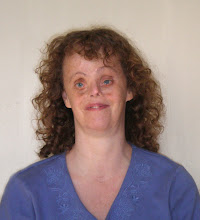
The past week has been all about realizing how I have allowed others' perceptions of me to shape my thinking. And, let me tell you, it's not good. I even know the route cause and the situation is entirely of my own making.
It began a while back when I decided to become a Kinder Gentler Jen. Accused of being "too independent" and having offered assistance rejected once too often, I decided to take a step back and go with the flow. Perhaps it would make life easier teaching me something important along the way. guess what I've learned? The expression about easier not necessarily being better has major merit.
The KGJ (Kinder Gentler Jen) Approach translated into two major changes or should I say capitulations, the first related to yoga. I have been taking classes entirely composed of non-disabled people since April 2009. Once I discovered the teacher whose approach best suited my needs, I let him dictate how I functioned in the classroom. His room, his rules, so I didn't move around without a guiding elbow, someone retrieved all my props, and I wasn't allowed to do things alone other students routinely performed solo. Tentative chirpings about being less dependent were met with observations that my ego was getting in the way. Rather than blast my teacher, I let it go thinking maybe he knew something I didn't.
A couple of weeks ago, as per usual, I sat on the floor at the end of class waiting to be retrieved. A student came by and said, "Oh, don't worry, he didn't forget you." It was in that moment that I realized a situation I allowed to happen was perpetuating images of disability I loathe.
The true extent of the problem emerged when I discussed it with someone, who has a good sense of disability issues, but hasn't known me long. He was baffled at my behavior, and questioned why I wasn't pushing back insisting upon treatment that felt right to me. Awareness of my passivity and tolerance of ablist attitudes crashed over me light a ten foot wave.
And that's not even the worst of it. Looking for a means to change the situation, I considered how to start doing what was denied to me. While I could sort out the mechanics, I realized I had no faith in my ability to carry them out. another's doubts had literally caused me to feel less capable.
My KGJ (i.e. Wimp) Approach extended beyond the yoga studio to friendships. Routinely people decline my offers of help or stop my efforts because a sighted person can do it faster, better, or easier. Before, I would get pissy, but now I simply accept it and walk away.
Recently when I mentioned ability in an area, it resulted in a request for help. I was literally shocked and ridiculously grateful which led to realization and more shock. Somehow I'd become convinced I had nothing to offer others that couldn't be done faster and better by another. Thinking back, I even noticed times when I should have offered aid but did not because I felt my efforts would be inadequate.
In other words, people thinking I can't do things combined with me not challenging those notions has eroded my sense of value and ability. It's... disgusting. On an intellectual level, I always knew how a person was treated impacted their self-assessment. Naively I assumed myself immune. Something about living so outside "normal" and "typical" endowed me with protection. The unfortunate truth is that I am not only influenced by others but don't seem to know how to fight back. KGJ has gone from an experiment into ingrained behavior patterns.
You have no idea how much this rocks my world in a bad way. This leads to a question: Can you kick yourself in the ass? Maybe I should consult the yoga instructor on how to go about it.
Wednesday, October 20, 2010


Friday, October 15, 2010
Canes Can Do More Than Tap Side to Side
Believe it or not, today is National White Cane Safety Day. I guess I was suppose to cover all my canes – I own six – in bubble wrap or something. I'm obviously a neglectful CaneMom. Instead I'm honoring them with a top ten list of ways these canes have been useful in arenas other than navigation.
10. A snake catcher. My friend swears my cane looks identical to the one in that movie with snakes on a plane.
9. Retrieving items that have rolled under the stove or refrigerator.
8. hailing a cab in NYC.
7. Checking the depth of a pool's shallow end.
6. While standing still to watch a musician's street performance, perching my hat on it's top.
5. Entertaining cats.
4. As the stem of a flower the year I was an even bigger flower for Halloween.
3. Measuring the empty rooms of my new apartment. My bedroom was something like 2.5 canes in one direction and 3 in the other.
2. Hanging wind chimes. In college, our rooms had these pipes near the ceiling for the sprinkler system. I stood on my dresser, tied the wind chimes around the pipe, then used my cane to push them over to the middle of my room.
1. To get a turtle out of the middle of a road. Rain was coming down in sheets as we drove up Route 116 near Amherst, Massachusetts and we came upon a turtle pretty much volunteering to be road kill. We were worried about touching it – it might have been a snapper – so we used the end of my cane to poke it in the most tender place on its backside. The procedure was continued until the tortoise reached the safety of the road's shoulder.
10. A snake catcher. My friend swears my cane looks identical to the one in that movie with snakes on a plane.
9. Retrieving items that have rolled under the stove or refrigerator.
8. hailing a cab in NYC.
7. Checking the depth of a pool's shallow end.
6. While standing still to watch a musician's street performance, perching my hat on it's top.
5. Entertaining cats.
4. As the stem of a flower the year I was an even bigger flower for Halloween.
3. Measuring the empty rooms of my new apartment. My bedroom was something like 2.5 canes in one direction and 3 in the other.
2. Hanging wind chimes. In college, our rooms had these pipes near the ceiling for the sprinkler system. I stood on my dresser, tied the wind chimes around the pipe, then used my cane to push them over to the middle of my room.
1. To get a turtle out of the middle of a road. Rain was coming down in sheets as we drove up Route 116 near Amherst, Massachusetts and we came upon a turtle pretty much volunteering to be road kill. We were worried about touching it – it might have been a snapper – so we used the end of my cane to poke it in the most tender place on its backside. The procedure was continued until the tortoise reached the safety of the road's shoulder.
Wednesday, October 13, 2010
Inspiring Lower Expectations
Tell a TAB that they are inspiring and the person will be aglow with pride. Compliment me in the same way and I'll duck my head and try to become invisible, which of course never works when I want. It is almost as bad as being told I'm amazing.
A seatmate on an airplane asked me a crucial question, "Isn't it good if by your example you cause another to do something worthwhile?" Since nobody can argue with that result, of course I agreed which began me thinking. What is so objectionable in being an inspiration?
I realized there are two forms of inspiration: the role model type and the amazing flavor. They differ in that in the former inspiration has led to act and achievement whereas the latter is focused on emotion.
Their common ground is that of expectation. In order for something to inspire, it must seem out of the ordinary for human behavior. An obstacle assessed as insurmountable must be overcome. Circumstances determined as utterly bleak must have been successfully plumbed for happiness. A perceived burden must be shouldered as though it is feather-light.
If it were simply about behavior out of the ordinary for human beings, I would have no objections to engendering inspiration, but it's not. People based their expectations on the limits they assume my disabilities impart. These constraints are typically based on socially perpetuated beliefs about disability as opposed to the reality. Thus people think I can't bake, so when I do they find it inspiring. This makes me crazy.
If the inspiration leads to an individual behaving differently and accomplishing something, I have more tolerance. Perhaps this is because the inspired person has perceived us to have common ground. They are not viewing me as other and setting the bar lower as a result. Instead they realize my reality has traits familiar because they are present in their own lives and use an identical yardstick to measure both of us. This feels far less like being thought less competent and hence less objectionable. It also helps that a person is getting more out of the comparisons than a surge of emotion.
It dawns upon me that there is a subset of inspiration that has always been nebulous to me. I tend to engage in these discussions when people start gushing about my amazingness and I feel obligated to object. Sometimes the person says something like, "I can't sow, so I'm amazed you made that skirt." When questioned, they seem genuinely convinced that it isn't my blindness that makes the act seem extraordinary, but rather the common ground we share as human beings.
So I suppose my objections to those who find me inspiring are solely related to whether or not the person sees us as the same or different. It's about whether they use the same yardstick to judge me as they use to judge themselves. The instant my disabilities inspire them to create a separate set of expectations, it becomes insulting. If the expectations were higher, I'd probably find it irritating, but somehow they're always lower.
A seatmate on an airplane asked me a crucial question, "Isn't it good if by your example you cause another to do something worthwhile?" Since nobody can argue with that result, of course I agreed which began me thinking. What is so objectionable in being an inspiration?
I realized there are two forms of inspiration: the role model type and the amazing flavor. They differ in that in the former inspiration has led to act and achievement whereas the latter is focused on emotion.
Their common ground is that of expectation. In order for something to inspire, it must seem out of the ordinary for human behavior. An obstacle assessed as insurmountable must be overcome. Circumstances determined as utterly bleak must have been successfully plumbed for happiness. A perceived burden must be shouldered as though it is feather-light.
If it were simply about behavior out of the ordinary for human beings, I would have no objections to engendering inspiration, but it's not. People based their expectations on the limits they assume my disabilities impart. These constraints are typically based on socially perpetuated beliefs about disability as opposed to the reality. Thus people think I can't bake, so when I do they find it inspiring. This makes me crazy.
If the inspiration leads to an individual behaving differently and accomplishing something, I have more tolerance. Perhaps this is because the inspired person has perceived us to have common ground. They are not viewing me as other and setting the bar lower as a result. Instead they realize my reality has traits familiar because they are present in their own lives and use an identical yardstick to measure both of us. This feels far less like being thought less competent and hence less objectionable. It also helps that a person is getting more out of the comparisons than a surge of emotion.
It dawns upon me that there is a subset of inspiration that has always been nebulous to me. I tend to engage in these discussions when people start gushing about my amazingness and I feel obligated to object. Sometimes the person says something like, "I can't sow, so I'm amazed you made that skirt." When questioned, they seem genuinely convinced that it isn't my blindness that makes the act seem extraordinary, but rather the common ground we share as human beings.
So I suppose my objections to those who find me inspiring are solely related to whether or not the person sees us as the same or different. It's about whether they use the same yardstick to judge me as they use to judge themselves. The instant my disabilities inspire them to create a separate set of expectations, it becomes insulting. If the expectations were higher, I'd probably find it irritating, but somehow they're always lower.
Wednesday, October 6, 2010
Body Image Rears Its Ugly Head
This is hard to write, not because I'm unearthing unfamiliar feelings but because I hate contemplating what it all means. Bottom line is that I feel like I've been incredibly wrong and failed. Both make me a wee bit crazy. Okay, fine, crazier.
It all began with a man and a crush. A few times in my presence, he very obviously noticed other attractive women, once almost turning completely around to keep the beauty in his sights. Because the crush had moments of it being mutual, I knew he was at least alright with my appearance, but each time he ogled another woman, I felt particularly ugly. Obviously what he was staring at was somehow superior to gazing at me.
Fast forward to this past spring. Two people – they're best friends – came into my life. Both have this habit of talking about other women with major emphasis on her beauty, her wardrobe, and the impact it has on them. It's like this constant barrage of reminders that appearance is noticed by everyone every second of the day. As a result, I am constantly aware of the fact that others notice me and since I know the majority of people out there have issues with how I look, it becomes a continuous prod at one of my vulnerable places.
An odd side effect of their constant noticing of other women is that when they say nice things about how I look, I discount them out of hand. They say it about everyone, diluting believability to almost nothing.
Then, of course, there's my lack of eyes. I've spent the majority of this year missing at least one eye-like entity from my head. At the moment, I have one prosthetic and one socket with a sort of blank in it. Dark glasses have been Ditched, so it's all there for anyone to see. And evaluate. Probably not all that favorably, because I doubt most think, "She's made a choice to not cover up anything. Good for her."
If you've read My Brain Hurts, you know that at least one person has vocalized their thoughts about my eyes, their disconcerting nature, and the strong opinion that I should hide them until I have prosthetics.
Before all of this happened, I was good with my appearance. Although I knew others had issues, I had a clarity that that was not my opinion and thus secondary to what I felt. With what seems like daily reminders of how much people notice appearance, my positive body image is cracking. It's not so much that I suddenly dislike how I look, but rather it's that my approval has been drowned out by a flood of other voices.
This has not been helped by things like the ophthalmic reconstructive surgeon asking, "Are you having more reconstructive surgery?" implying there was something needing fixing. No small children have run screaming, but my brain argues it's a fluke.
I have gained a new found love of my blindness. Constant visuals of how others look in relation to my own image would be making this far worse. Actually, it's highly likely that my positive body image was possible only because I lacked the vision to see how much my appearance diverged from what's acceptable. Maybe what I proclaim about self-acceptance and body image can't fairly be applied to sighted people. Maybe if I could see myself clearly I'd be horrified.
I like to think I have this great body image and I'm finding it hard to admit right now I feel out of touch with those positive feelings. My approval is buried under this thick layer of muck composed of a continual awareness that everyone is evaluating me and a certain knowledge that most aren't staring out of a desire to gaze upon something attractive.
I abhor the fact that my body image is being so twisted. There's a self consciousness within me that I've never experienced in quite this way. The thing I hate most, though, is the fear that my body image can only be positive because I have built a world that allows me to be oblivious to other's perceptions. If I lived in reality, I couldn't possibly maintain anything close to a positive body image. Therefore, denial becomes an essential component of liking my appearance. Denial isn't healthy making me not healthy. Peachy.
It all began with a man and a crush. A few times in my presence, he very obviously noticed other attractive women, once almost turning completely around to keep the beauty in his sights. Because the crush had moments of it being mutual, I knew he was at least alright with my appearance, but each time he ogled another woman, I felt particularly ugly. Obviously what he was staring at was somehow superior to gazing at me.
Fast forward to this past spring. Two people – they're best friends – came into my life. Both have this habit of talking about other women with major emphasis on her beauty, her wardrobe, and the impact it has on them. It's like this constant barrage of reminders that appearance is noticed by everyone every second of the day. As a result, I am constantly aware of the fact that others notice me and since I know the majority of people out there have issues with how I look, it becomes a continuous prod at one of my vulnerable places.
An odd side effect of their constant noticing of other women is that when they say nice things about how I look, I discount them out of hand. They say it about everyone, diluting believability to almost nothing.
Then, of course, there's my lack of eyes. I've spent the majority of this year missing at least one eye-like entity from my head. At the moment, I have one prosthetic and one socket with a sort of blank in it. Dark glasses have been Ditched, so it's all there for anyone to see. And evaluate. Probably not all that favorably, because I doubt most think, "She's made a choice to not cover up anything. Good for her."
If you've read My Brain Hurts, you know that at least one person has vocalized their thoughts about my eyes, their disconcerting nature, and the strong opinion that I should hide them until I have prosthetics.
Before all of this happened, I was good with my appearance. Although I knew others had issues, I had a clarity that that was not my opinion and thus secondary to what I felt. With what seems like daily reminders of how much people notice appearance, my positive body image is cracking. It's not so much that I suddenly dislike how I look, but rather it's that my approval has been drowned out by a flood of other voices.
This has not been helped by things like the ophthalmic reconstructive surgeon asking, "Are you having more reconstructive surgery?" implying there was something needing fixing. No small children have run screaming, but my brain argues it's a fluke.
I have gained a new found love of my blindness. Constant visuals of how others look in relation to my own image would be making this far worse. Actually, it's highly likely that my positive body image was possible only because I lacked the vision to see how much my appearance diverged from what's acceptable. Maybe what I proclaim about self-acceptance and body image can't fairly be applied to sighted people. Maybe if I could see myself clearly I'd be horrified.
I like to think I have this great body image and I'm finding it hard to admit right now I feel out of touch with those positive feelings. My approval is buried under this thick layer of muck composed of a continual awareness that everyone is evaluating me and a certain knowledge that most aren't staring out of a desire to gaze upon something attractive.
I abhor the fact that my body image is being so twisted. There's a self consciousness within me that I've never experienced in quite this way. The thing I hate most, though, is the fear that my body image can only be positive because I have built a world that allows me to be oblivious to other's perceptions. If I lived in reality, I couldn't possibly maintain anything close to a positive body image. Therefore, denial becomes an essential component of liking my appearance. Denial isn't healthy making me not healthy. Peachy.
Saturday, October 2, 2010
It Gets Better
Dan Savage, sex columnist extraordinaire, has embarked on a mission to give hope to lesbian, bisexual, gay, and transgendered (LBGT) youth who are facing ridicule and bulling from their peers. Called the It Gets Better Project, the point is to talk about how good life can be once you leave the harsh high school environment. For more information, go here.
As I watched the accompanying video, I began considering how much the equivalent was needed for disabled teens who face similar potentially rough high school years. I can totally tell a bunch of kids that it does get better, right? Actually, not exactly.
Granted, my high school years were a kind of miserable that I haven't experienced since and I prefer now to then without question, but the issues I had back then with people's attitudes and behavior hasn't magically morphed into some idyllic world. I struggled with social isolation, people not understanding, and being underestimated as a teen. From my blog, you can tell that it hasn't particularly changed.
When an LBGT teen leaves high school and either enters the work force or goes off to college, they are suddenly endowed with freedom allowing them to pick their friends, environment, and activities. eventual financial independence strips away the last of the constraints on lifestyle choices. In modern times and with modern conveniences, Jane doesn't need Dick to survive and thrive.
As anyone with a physical disability can tell you, we need other people on a regular basis. It is as much a fact of life as the need for oxygen. This reliance on others places constraints on our lives – on our choices.
From buying groceries to reading annoying print mail, I rely upon people to do things small and large. If Jane wants to have dinner with Joan, she gets herself to the desired place, meets her friend, picks her meal from the menu options, pays her portion of the bill by glancing at the check and adding things up, then gets herself home. When I want to have dinner with a friend, I must figure out how I'm getting there, pick a place that can feed me, rely upon my companion to read the menu, ask someone to tell me how much my food cost, and arrange for a way home. It's a completely different reality full of limitations on my choices.
Savage's It Gets Better Project essentially tells LBGT youth that life will improve because they will have the ability to shape their lives. If I were to start an It Gets Better Project for disabled youth, I would have a different sort of message. In fact, my project would more accurately be called the You Get Better Project because while I face the same issues now, I feel radically different about myself and that makes all the difference in the world.
As I watched the accompanying video, I began considering how much the equivalent was needed for disabled teens who face similar potentially rough high school years. I can totally tell a bunch of kids that it does get better, right? Actually, not exactly.
Granted, my high school years were a kind of miserable that I haven't experienced since and I prefer now to then without question, but the issues I had back then with people's attitudes and behavior hasn't magically morphed into some idyllic world. I struggled with social isolation, people not understanding, and being underestimated as a teen. From my blog, you can tell that it hasn't particularly changed.
When an LBGT teen leaves high school and either enters the work force or goes off to college, they are suddenly endowed with freedom allowing them to pick their friends, environment, and activities. eventual financial independence strips away the last of the constraints on lifestyle choices. In modern times and with modern conveniences, Jane doesn't need Dick to survive and thrive.
As anyone with a physical disability can tell you, we need other people on a regular basis. It is as much a fact of life as the need for oxygen. This reliance on others places constraints on our lives – on our choices.
From buying groceries to reading annoying print mail, I rely upon people to do things small and large. If Jane wants to have dinner with Joan, she gets herself to the desired place, meets her friend, picks her meal from the menu options, pays her portion of the bill by glancing at the check and adding things up, then gets herself home. When I want to have dinner with a friend, I must figure out how I'm getting there, pick a place that can feed me, rely upon my companion to read the menu, ask someone to tell me how much my food cost, and arrange for a way home. It's a completely different reality full of limitations on my choices.
Savage's It Gets Better Project essentially tells LBGT youth that life will improve because they will have the ability to shape their lives. If I were to start an It Gets Better Project for disabled youth, I would have a different sort of message. In fact, my project would more accurately be called the You Get Better Project because while I face the same issues now, I feel radically different about myself and that makes all the difference in the world.
Subscribe to:
Posts (Atom)